

Stainless steel 316 and 316L are widely used for fittings that handle water, oil, gas, chemicals and other demanding fluids. The two grades are very similar in corrosion resistance and general mechanical performance, but they are not identical.
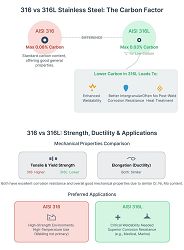
The main difference is carbon content. 316L has a lower carbon limit than 316, which gives it an advantage in welded assemblies and applications where the fitting may be exposed to repeated welding or elevated temperatures.
For threaded fittings, compression fittings and reusable hydraulic hose fittings, however, material selection should be based on more than the grade name. Tube or hose material, pressure, temperature, media, connection type, fabrication method and the surrounding environment all need to be considered.
316 vs 316L Stainless Steel: What Is the Difference?
Both 316 and 316L are austenitic stainless steels containing chromium, nickel and molybdenum. The molybdenum content is particularly important because it improves resistance to localized corrosion compared with common 304 stainless steel.
The key difference is carbon content:
|
Property |
316 Stainless Steel |
316L Stainless Steel |
|
Stainless steel family |
Austenitic |
Austenitic |
|
Chromium |
Approx. 16–18% |
Approx. 16–18% |
|
Nickel |
Approx. 10–14% |
Approx. 10–14% |
|
Molybdenum |
Approx. 2–3% |
Approx. 2–3% |
|
Carbon |
Higher than 316L |
≤0.03% |
|
Corrosion resistance |
Very good |
Very good |
|
Weldability |
Good |
Better for welded construction |
|
Post-weld corrosion resistance |
Good when properly processed |
Better |
|
Typical fitting use |
Machined, threaded, hydraulic and industrial fittings |
Welded and corrosion-sensitive assemblies |
Actual chemical composition should be confirmed against the material standard and mill certificate for the specific fitting being purchased.
Why Does the "L" Matter?
The "L" in 316L means low carbon.
During welding, stainless steel can be exposed to temperatures that cause chromium carbides to form around grain boundaries. Excessive carbide precipitation can reduce corrosion resistance in the affected area.
The lower carbon content of 316L reduces this risk.
This is why 316L is commonly selected for:
- Welded tube assemblies
- Process piping
- Chemical equipment
- Pharmaceutical equipment
- Food processing equipment
- Marine equipment
- Corrosive service
- Fabricated stainless steel systems
For a fully machined threaded fitting that does not require welding, the advantage of 316L may be less important.
316L vs 316 Corrosion Resistance
In many normal service conditions, 316 and 316L provide very similar corrosion resistance.
Both grades contain molybdenum and are suitable for environments where resistance to chlorides, moisture and many industrial fluids is important.
The practical difference becomes more noticeable when the fitting is welded or fabricated.
For example, a stainless steel tube system may contain several welded joints. In this case, 316L can reduce the risk of corrosion associated with welding and subsequent heat exposure.
For machined fittings, the surrounding environment and fitting design often have a greater influence on service life than the small difference between 316 and 316L.
316 vs 316L for Hydraulic Fittings
Material selection for hydraulic fittings should start with the working conditions.
HBFittings supplies stainless steel reusable hydraulic hose fittings with SS316, SS304 and 316L body material options. Its reusable fittings are offered with JIC, BSP, BSPT and NPT thread configurations and are designed for high-pressure hydraulic hose applications.
For hydraulic systems, consider:
- Working pressure
- Hose construction
- Hose inside diameter
- Thread standard
- Fluid type
- Operating temperature
- External corrosion
- Frequency of assembly and maintenance
- Whether welding is involved
If the fitting is machined and assembled directly onto a hydraulic hose, 316 and 316L can both be suitable when the selected grade meets the required material and service specifications.
If the stainless steel assembly includes welding, 316L is usually the more appropriate choice.
316L vs 316 for Compression Tube Fittings
Compression fittings use mechanical tube gripping rather than welding.
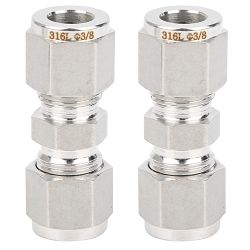
A typical compression fitting consists of a fitting body, ferrule and nut. HBFittings lists stainless steel compression fittings in SS304, SS316, SS304L, SS316L and A105, covering inch and metric tube sizes.
For this type of fitting, the buyer should focus on:
Tube Material
316/316L stainless tube, 304/304L stainless tube, copper, or other compatible tubing may require different fitting specifications.
Tube Outside Diameter
The ferrule and fitting body must match the actual tube OD. Inch and metric dimensions should not be mixed.
Pressure
Do not select a fitting solely by material grade. The pressure rating depends on fitting design, tube size, connection configuration, material and service conditions.
Sealing Method
Compression, double ferrule, flare and threaded connections have different installation requirements and sealing mechanisms.
Welding Requirement
If the fitting itself is part of a welded assembly, 316L becomes more attractive because of its lower carbon content.
316L vs 316 for JIC Hydraulic Fittings
JIC fittings use a 37° flare connection and are commonly used in hydraulic systems.
HBFittings offers stainless steel female JIC 37° swivel reusable hydraulic hose fittings with SS316, SS304 and 316L material options. The product uses a precision-machined 37° flare and is specified to SAE J514.
For JIC fittings, material selection should be separated from connection selection.
A buyer should first confirm:
Hose → fitting size → JIC connection → thread → pressure requirement → material → environment
For marine, chemical or highly corrosive environments, stainless steel 316/316L may be preferred over 304.
If no welding is involved, the performance difference between 316 and 316L may not justify choosing 316L solely because it has the "L" designation.
When Should You Choose 316?
316 is a practical choice for machined stainless steel fittings when:
- The fitting is not welded
- Corrosion resistance is required
- The application uses hydraulic hose or tubing
- The fitting is threaded or mechanically connected
- The material specification calls for 316
- Cost and availability are important
- The service environment does not require the lower-carbon grade
Typical products include:
- Hydraulic hose fittings
- JIC fittings
- BSP fittings
- NPT fittings
- Compression fittings
- Tube connectors
- Pipe nipples
- Adapters
- Instrumentation fittings
When Should You Choose 316L?
316L is the better material choice when:
- Welding is part of the manufacturing process
- The fitting will be welded to stainless steel tubing
- The system operates in a corrosive environment
- Post-weld corrosion resistance is important
- Pharmaceutical or food-processing requirements favor low-carbon stainless steel
- The project specification specifically requires 316L
- Material traceability is required for critical process equipment
For welded process piping, the lower carbon content is the main reason to specify 316L rather than simply selecting it because it is considered a "higher grade."
316 vs 316L: Which One Is More Corrosion Resistant?
For unwelded fittings, there is no simple answer that 316L is always more corrosion resistant than 316.
The two grades have very similar base corrosion resistance because their chromium, nickel and molybdenum ranges are closely related.
The important difference appears after welding.
For machined fitting → 316 and 316L can have very similar corrosion performance.
For welded fitting → 316L normally provides a better margin against weld-related corrosion.
This distinction is important when writing a specification or comparing supplier quotations.
316 vs 316L Fittings: Cost Considerations
316L may carry a higher material or procurement cost depending on the supplier, production batch and availability.
For standard threaded fittings, paying extra for 316L may not provide a meaningful operational benefit if there is no welding requirement.
For fabricated systems, however, the material premium can be easier to justify because the lower carbon grade is better suited to welded stainless steel construction.
A procurement comparison should therefore consider the total specification, rather than comparing 316 and 316L by price per piece alone.
What to Check When Buying 316 or 316L Fittings
Before placing a purchase order, specify the following information:
|
Item |
What to Confirm |
|
Material |
316 or 316L |
|
Material certificate |
Required / not required |
|
Fitting type |
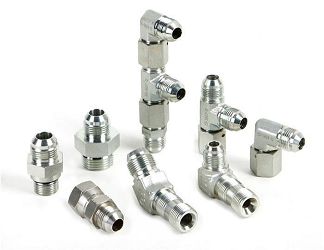
Elbow, tee, union, adapter, nipple, compression fitting, hydraulic fitting |
|
Connection |
Threaded, compression, JIC, flare, welded |
|
Thread |
NPT, BSPP, BSPT, JIC, metric, etc. |
|
Size |
Inch or metric |
|
Tube OD |
Exact outside diameter |
|
Hose |
Model and construction if applicable |
|
Pressure |
Working and test requirements |
|
Temperature |
Minimum and maximum operating temperature |
|
Media |
Water, oil, gas, steam, chemicals, etc. |
|
Surface |
Machined, polished or specified finish |
|
Inspection |
Dimensional, pressure or material inspection |
|
Certification |
ISO, material certificate, pressure certificate or project-specific documents |
HBFittings states that its stainless steel reusable hydraulic hose fittings support material certificates and pressure certificates, and its product range includes customized sizes.
316 vs 316L: Quick Selection
Choose 316 when:
You need a corrosion-resistant stainless steel fitting for a mechanically assembled hydraulic, tube or pipe connection and there is no specific welding requirement.
Choose 316L when:
The fitting is welded, forms part of a fabricated stainless steel system, or the project specification requires low-carbon stainless steel.
If you are unsure:
Provide the supplier with the fluid, pressure, temperature, tube/hose size, connection type and installation method. These details are more useful for material selection than simply asking for a "316 stainless fitting."
316 and 316L Fittings from HBFittings
HBFittings' stainless steel fitting range includes compression tube fittings, double-ferrule fittings, hydraulic hose fittings, JIC fittings and other stainless steel connection products. The website lists SS316 and 316L among available materials for several fitting products, together with SS304 and other material options.
For OEM and non-standard requirements, HBFittings also states that fittings can be produced according to customer drawings or samples.
Explore Stainless Steel Fittings from HBFittings


