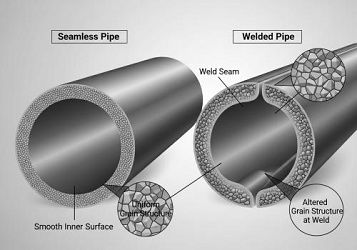
Seamless and welded stainless steel fittings are both used in industrial piping, instrumentation, hydraulic systems, chemical processing and fluid handling. The main difference is how the starting tube or fitting body is produced.
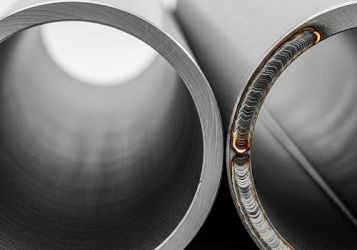
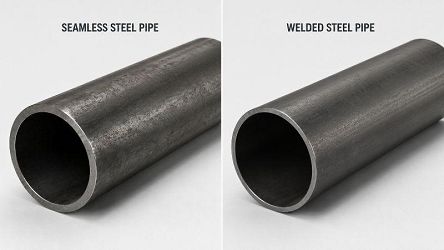
A seamless fitting is manufactured without a longitudinal weld seam. A welded fitting starts from welded stainless steel material, where the strip or plate is formed and joined before the fitting is produced.
This difference does not automatically make one type suitable for every application. The right choice depends on pressure, temperature, pipe size, media, connection method, fabrication requirements and applicable standards.
Seamless vs Welded Stainless Steel Fittings
|
Item |
Seamless Stainless Steel Fittings |
Welded Stainless Steel Fittings |
|
Manufacturing |
No longitudinal weld seam |
Produced from welded material |
|
Weld seam |
None in the starting tube |
Present in the starting material |
|
Pressure applications |
Often preferred for demanding service |
Suitable when design and specification permit |
|
High-temperature service |
Common choice |
Depends on material and weld quality |
|
Inspection |
Dimensional and material inspection |
Weld and dimensional inspection may be required |
|
Large sizes |
More difficult and costly depending on process |
Often more practical |
|
Surface consistency |
Generally uniform |
Depends on weld and finishing process |
|
Cost |
Usually higher |
Often more economical |
|
Fabrication |
Suitable for critical piping |
Suitable for many fabricated systems |
|
Typical use |
High-pressure, critical piping, instrumentation |
General industrial piping and larger fabricated systems |
The table is a purchasing starting point rather than a substitute for the applicable fitting standard and project specification.
What Is a Seamless Stainless Steel Fitting?
A seamless stainless steel fitting is made from stainless steel material without a longitudinal welded joint in the starting pipe or tube.
Seamless construction is commonly associated with applications where the piping system operates under demanding pressure or temperature conditions.
For small-bore industrial fittings, however, the word "seamless" should not be confused with "forged." These are different manufacturing concepts.
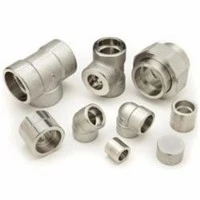
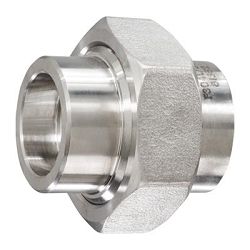
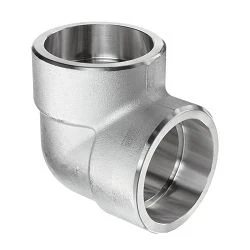
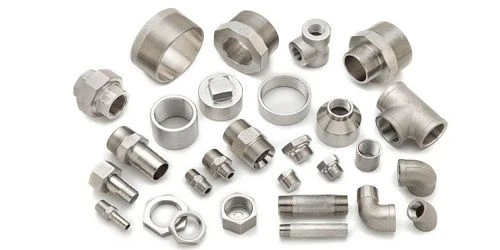
HBFittings, for example, lists forged stainless steel pipe fittings manufactured by forging and CNC machining. Its product range includes socket-weld and threaded configurations, with stainless steel, carbon steel, alloy steel, super duplex and nickel-based alloys available depending on the product.
What Is a Welded Stainless Steel Fitting?
A welded stainless steel fitting is produced using stainless steel material that has been formed and joined by welding, or the fitting itself is installed into a piping system through welding.
The term can therefore refer to two different things:
- Welded manufacturing construction
- Welded connection to the pipeline
These should not be treated as the same specification.
For example, a fitting may be manufactured from seamless stainless steel but have a socket-weld connection. HBFittings offers forged stainless steel fittings with socket-weld connections, including elbows and swage nipples.
This distinction is important when comparing supplier quotations.
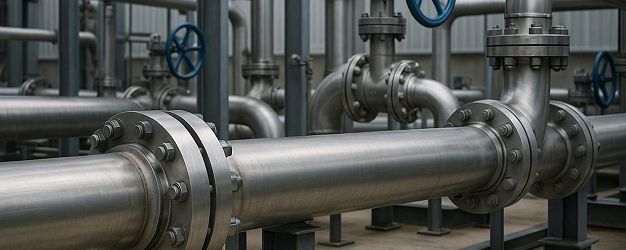
Seamless Stainless Steel Fittings for High-Pressure Systems
For high-pressure piping, buyers normally pay close attention to material integrity, wall thickness, fitting geometry, connection design and pressure class.
HBFittings lists forged stainless steel fittings in pressure classes such as 2000LB, 3000LB and 6000LB, depending on the product. Its forged 316 stainless steel swage nipple is specified for liquid, gas, steam and oil service and is manufactured through forging followed by machining and inspection.
For high-pressure procurement, do not select a fitting based on "seamless" alone.
Check:
- Pressure class
- Pipe schedule
- Fitting size
- Material grade
- Connection type
- Temperature
- Fluid
- Applicable standard
- Test requirements
A properly specified forged fitting can be more relevant to a high-pressure application than simply choosing a fitting described as seamless.
Seamless vs Welded Fittings for Chemical Processing
Chemical processing systems can expose fittings to corrosive liquids, gases, elevated temperatures and pressure fluctuations.
Material grade becomes particularly important.
HBFittings' stainless steel range includes 304, 316 and 316L, as well as other stainless and special-alloy options. Its stainless steel four-way fittings are listed for oil, water, gas and corrosive media, with 304 and 316 stainless steel options.
For chemical service, evaluate the following together:
Material + manufacturing method + connection + pressure + temperature + media
Choosing 316 instead of 304 may be more important than choosing seamless instead of welded when corrosion is the primary concern.
For welded stainless steel assemblies, 316L may also be specified where low-carbon stainless steel is required.
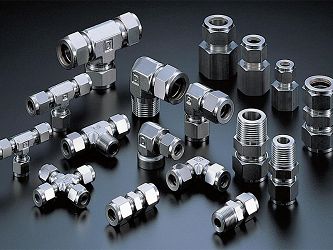
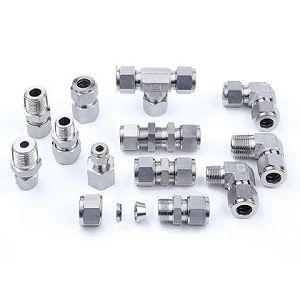
Seamless vs Welded for Stainless Steel Compression Fittings
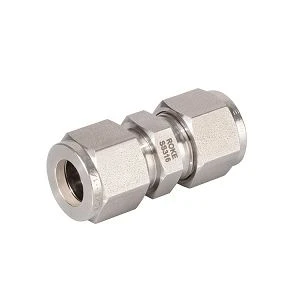
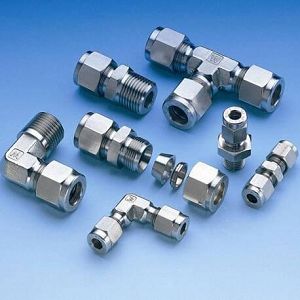
Compression fittings are different from butt-weld fittings because the tube is mechanically sealed by the fitting, ferrule and nut.
HBFittings lists stainless steel compression fittings in:
- SS304
- SS316
- SS304L
- SS316L
- A105
Its product range includes compression unions, elbows and tees, with inch and metric tube sizes. Some listed stainless steel compression products are rated up to 6000 psi, depending on the specific design and configuration.
For compression tube fittings, buyers should focus on:
Tube OD
The fitting must match the actual outside diameter of the tube.
Tube Material
The tube material affects ferrule selection, grip and sealing performance.
Fitting Material
SS316 and SS316L are common choices for corrosion-sensitive systems.
Pressure
Use the manufacturer's rating for the exact fitting, tube size and configuration.
Connection
Compression, double ferrule, threaded, JIC and welded connections have different installation requirements.
A seamless tube does not automatically mean the complete connection is suitable for high pressure. The tube, fitting and assembly method must be compatible.
Seamless vs Welded Stainless Steel Fittings for Hydraulic Systems
Hydraulic fittings operate under pressure, vibration and repeated pressure cycles.
HBFittings' product range includes stainless steel hydraulic hose fittings, JIC fittings, BSP fittings, reusable hose fittings and other hydraulic connections. Its reusable hydraulic fittings are available in SS304, SS316 and 316L depending on the product.
For hydraulic applications, the manufacturing method is only one part of the selection process.
Check:
- Hose type
- Hose ID
- Fitting size
- Thread standard
- Working pressure
- Test pressure
- Fluid
- Temperature
- Material
- Vibration
- Installation method
A forged stainless steel fitting may be preferable for certain high-pressure pipe applications, while a reusable hydraulic hose fitting may be more appropriate where field assembly and hose replacement are required.
Seamless vs Welded: Strength Considerations
A common purchasing mistake is to assume:
Seamless = stronger
Welded = weaker
The actual situation is more complicated.
Fitting strength depends on:
- Material grade
- Wall thickness
- Manufacturing process
- Fitting geometry
- Weld quality
- Heat treatment
- Machining accuracy
- Pressure class
- Applicable standard
For welded fittings, the quality of the weld and heat-affected area must be controlled.
For seamless fittings, the absence of a longitudinal weld does not eliminate the need for proper forming, heat treatment, machining and inspection.
For critical applications, the fitting's certified pressure rating and applicable standard are more useful purchasing criteria than the word "seamless" by itself.
Seamless vs Welded Stainless Steel Fittings: Manufacturing
Seamless Fitting Manufacturing
A typical production route may include:
Raw material → forming/forging → heat treatment → machining → surface treatment → inspection → marking → packaging
HBFittings' forged 316 stainless steel fitting process is described as feeding, re-inspection, cutting, heating, forging, heat treatment, trimming, shot blasting, drilling, machining, marking, inspection and packaging.
Welded Fitting Manufacturing
A welded fitting may involve:
Stainless steel strip/plate → forming → welding → heat treatment → sizing → cutting/forming → machining → inspection → finishing
The exact route depends on the fitting type, material and production specification.
For procurement, ask the supplier which process is actually being used instead of relying on a product title containing "seamless" or "welded."
Standards for Stainless Steel Fittings
The standard should be confirmed before ordering.
HBFittings lists several standards for its forged pipe fittings, including:
- ASME B16.11
- GB/T 14383-2018
- BS-3799
Its forged fittings include threaded and socket-weld configurations and are offered in multiple pressure classes.
For butt-weld fittings, different standards may apply depending on fitting type, material and application.
The purchase order should state the required standard instead of simply specifying "stainless steel fitting."
When Should You Choose Seamless Stainless Steel Fittings?
Seamless construction is worth considering when:
- The system has demanding pressure requirements
- The project specification requires seamless construction
- The fitting is part of critical process piping
- High temperature is involved
- Weld seam elimination is important
- The applicable standard calls for seamless construction
- Material traceability and inspection requirements are strict
For small-bore high-pressure applications, forged stainless steel fittings may also be a better specification than a generic seamless fitting.
When Are Welded Stainless Steel Fittings a Good Choice?
Welded construction can be appropriate when:
- Larger pipe sizes are required
- The project specification permits welded fittings
- Cost control is important
- The system uses conventional industrial piping
- The fabrication shop has qualified welding procedures
- Weld inspection requirements can be met
- The application does not require seamless construction
- Welded fittings should not be rejected simply because they contain a weld.
The relevant question is whether the manufacturing process, weld quality and finished fitting meet the required specification.
Seamless vs Welded Stainless Steel Fittings: Cost
Seamless fittings often cost more because manufacturing the starting material and forming the fitting can require more processing.
Welded fittings can provide a more economical route, particularly for larger sizes and certain fabricated applications.
However, price should be compared against the complete specification:
Material + size + wall thickness + pressure class + connection + standard + inspection + certification
A cheaper fitting with the wrong pressure class or material is not a lower-cost solution.
Seamless vs Welded Stainless Steel Fittings Buying Checklist
Before requesting a quotation, provide the supplier with:
|
Specification |
Example |
|
Fitting type |
Elbow / Tee / Union / Nipple / Cross / Reducer |
|
Material |
SS304 / SS316 / SS316L |
|
Manufacturing |
Seamless / Welded / Forged |
|
Connection |
Threaded / Socket Weld / Butt Weld / Compression |
|
Size |
1/4"–4" or metric |
|
Thread |
NPT / BSPP / BSPT / Metric |
|
Pressure class |
2000LB / 3000LB / 6000LB |
|
Tube/pipe |
OD, schedule or wall thickness |
|
Media |
Water / Oil / Gas / Steam / Chemical |
|
Temperature |
Operating range |
|
Standard |
ASME / ASTM / EN / GB / Project standard |
|
Certification |
MTC / pressure test / inspection report |
|
Surface |
Machined / polished / passivated |
|
Quantity |
Trial order / production quantity |
Seamless vs Welded Stainless Steel Fittings: Final Selection
There is no universal rule that seamless stainless steel fittings are always better than welded fittings.
Choose according to the actual service conditions.
For high-pressure and critical piping:
Review forged or seamless construction, pressure class, material and applicable standards together.
For welded process systems:
Pay close attention to weld procedure, heat treatment, inspection and material grade.
For instrumentation tubing:
Compression and double-ferrule fittings may be more relevant than seamless/welded classification.
For hydraulic hose systems:
Focus on fitting type, hose compatibility, thread, pressure rating and material.
For corrosive environments:
Material selection such as 316 or 316L may have a greater impact than the seamless/welded distinction.
Stainless Steel Fitting Options from HBFittings
HBFittings covers several stainless steel fitting categories, including compression tube fittings, quick connectors, hydraulic fittings, reusable hose fittings and forged pipe fittings. The current stainless steel range includes SS304, SS316 and SS316L products, while its forged fitting range covers socket-weld and threaded configurations.
For custom orders, the fitting specification should be submitted with the required material, dimensions, connection type, pressure class and applicable standard. HBFittings' product pages also indicate support for customized sizes on selected forged fittings.
Seamless vs Welded Structure
Forged Stainless Steel Fittings
Compression / Instrumentation Fittings
High Pressure Stainless Steel Piping