Threaded and welded pipe fittings are two common ways to connect pipes in industrial piping systems.
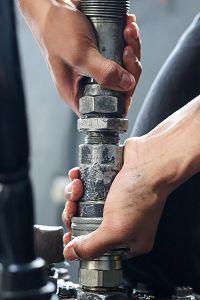
A threaded fitting uses male and female threads to create a mechanical connection. Depending on the thread type, sealing may rely on thread interference, a gasket, an O-ring or a thread sealant.
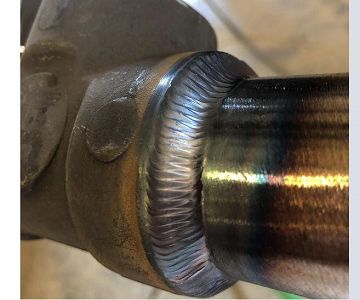
A welded fitting creates a permanent joint by joining the pipe and fitting through welding.
Neither connection is automatically better. The right choice depends on pipe size, pressure, temperature, fluid, installation conditions, maintenance requirements and the applicable piping standard.
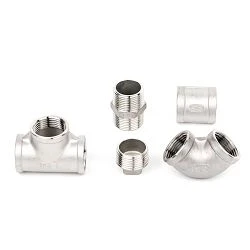
HBFittings supplies both threaded and welded pipe fittings, including NPT, BSPP and BSPT threaded configurations and forged socket-weld fittings. Its forged pipe fitting range covers stainless steel, carbon steel, alloy steel, super duplex and nickel-based alloys.
Threaded vs Welded Pipe Fittings
|
Item |
Threaded Pipe Fittings |
Welded Pipe Fittings |
|
Connection |
Mechanical threaded connection |
Welded permanent connection |
|
Installation |
Fast, no welding equipment |
Requires qualified welding process |
|
Removal |
Easy to remove |
Requires cutting and re-welding |
|
Maintenance |
Convenient for replacement |
More difficult to disassemble |
|
Leakage risk |
Depends on thread and sealing method |
Properly welded joint provides high integrity |
|
Field installation |
Convenient |
Requires welding equipment and procedures |
|
Small-bore piping |
Common choice |
Also widely used |
|
High-pressure service |
Suitable for specified ratings |
Common for demanding piping systems |
|
Vibration |
Depends on design and installation |
Generally stable when properly welded |
|
Modification |
Easy to change |
More difficult |
|
Labor |
Lower installation labor in many cases |
Higher installation labor |
|
Typical use |
Instrumentation, utilities, hydraulic and industrial lines |
Process piping, high-integrity and permanent piping |
The fitting rating, pipe specification and applicable standard should always take priority over a general threaded-versus-welded comparison.
What Are Threaded Pipe Fittings?
Threaded pipe fittings connect pipes by means of machined threads.
Common thread standards include:
- NPT
- BSPP
- BSPT
- Metric threads
- Other project-specific thread standards
HBFittings' product range includes stainless steel and other threaded fittings using NPT, BSPP and BSPT configurations. Its forged threaded fittings are available in sizes from 1/8" to 4" on selected products, with pressure classes including 2000LB, 3000LB and 6000LB.
Thread selection must be confirmed before ordering. NPT and BSP threads should not be treated as interchangeable.
For example, HBFittings describes NPT as an ASME B1.20.1 tapered pipe thread with a 60° thread form and 1:16 taper. Thread interference together with an appropriate sealant is used to achieve sealing.
What Are Welded Pipe Fittings?
Welded pipe fittings are joined to the pipe by welding.
There are several welded connection methods, depending on the piping design:
- Socket weld
- Butt weld
- Fillet weld
- Other project-specific welding configurations
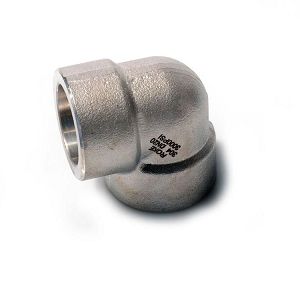
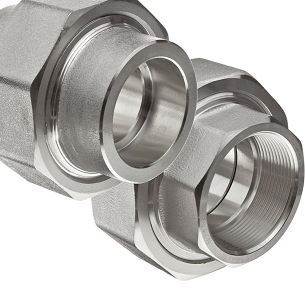
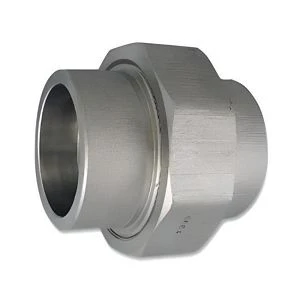
HBFittings offers forged socket-weld elbows and other forged fittings for small-bore piping. Its high-pressure socket-weld elbow range includes stainless steel and other alloy options, with 3000LB, 6000LB and 9000LB pressure classes listed for the product.
For a welded piping system, the fitting itself is only one part of the joint. Welding procedure, welder qualification, pipe material, heat treatment and inspection requirements may also affect the finished connection.
Threaded Fittings: Advantages
Easy Installation
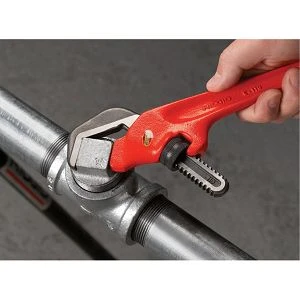
Threaded fittings can normally be installed with standard pipe tools rather than welding equipment.
This can reduce installation time for small piping modifications, maintenance work and field connections.
Easy Removal
A threaded fitting can be unscrewed and replaced without cutting the pipe.
This is useful for:
- Equipment maintenance
- Instrument replacement
- Temporary piping
- Small-bore utility lines
- Frequently serviced connections
Convenient for Field Work
Threaded connections are useful when welding equipment is unavailable or when hot work needs to be minimized.
This can be particularly useful during maintenance or retrofit work.
Threaded Fittings: Limitations
Threaded connections also have limitations.
Thread Sealing
A threaded joint must be assembled correctly.
The thread standard, engagement, sealant and installation torque all affect sealing performance.
For tapered threads such as NPT, thread interference and sealant work together to form the seal.
Limited by Pipe Size and Service
Threaded connections are more commonly associated with smaller pipe sizes. For larger process piping, welded or flanged connections may be more practical.
Maintenance Under Vibration
Repeated vibration, thermal cycling or improper assembly can affect a threaded connection. The actual suitability depends on the fitting design and service conditions.
Welded Fittings: Advantages
Permanent Connection
A welded joint does not rely on removable threads.
Once properly welded, the fitting becomes part of the piping assembly.
High Joint Integrity
Welding can provide a strong connection when the joint is properly designed, prepared, welded and inspected.
This makes welded connections suitable for many process, chemical, oil and gas, power and industrial piping systems.
No Internal Thread Engagement
A welded joint eliminates the need for pipe threads at the connection point.
This can be useful where the piping design requires a continuous welded connection.
Welded Fittings: Limitations
More Installation Equipment
Welding requires appropriate equipment, qualified personnel and suitable working conditions.
Hot Work
Welding introduces heat into the work area and may require hot-work controls depending on the facility.
Difficult to Remove
If a welded fitting needs to be replaced, the joint normally has to be cut and a new fitting welded into position.
Inspection Requirements
Depending on the application, welded joints may require visual inspection, dimensional inspection, non-destructive testing or other project-specific checks.
Threaded vs Welded Fittings for High-Pressure Piping
Pressure rating should be one of the first items checked when selecting a fitting.
HBFittings' forged pipe fitting range includes threaded and socket-weld configurations and pressure classes such as 2000LB, 3000LB and 6000LB. Certain socket-weld elbow products are listed at 3000LB, 6000LB and 9000LB.
This illustrates an important purchasing point:
Do not select a fitting only because it is threaded or welded.
The complete pressure specification should include:
- Fitting type
- Nominal pipe size
- Wall thickness or schedule
- Material
- Pressure class
- Operating temperature
- Fluid
- Connection type
- Applicable standard
For high-pressure service, the fitting's rated pressure at the actual operating temperature is more meaningful than a generic statement such as "welded fittings are stronger."
Threaded vs Welded for Stainless Steel Fittings
Stainless steel is widely used where corrosion resistance is important.
HBFittings' stainless steel product range includes SS304, SS316 and SS316L materials. The range covers compression fittings, tube fittings, hydraulic fittings and other stainless steel connection products.
For threaded stainless steel fittings, the buyer should specify:
Material + thread + size + pressure + media + temperature
For welded stainless steel fittings, add:
Welding method + pipe specification + weld requirements + inspection
If the system handles corrosive media, material selection may be more important than the connection type.
For example, 316 stainless steel may be selected instead of 304 where greater corrosion resistance is required.
Threaded vs Welded for Hydraulic Systems
Hydraulic systems require additional attention to pressure, vibration, hose compatibility and sealing.
HBFittings supplies stainless steel reusable hydraulic hose fittings with threaded configurations including JIC, BSP, BSPT and NPT. The products are available in SS304, SS316 and 316L and are intended for hydraulic hose applications.
For hydraulic hose connections, a threaded fitting may be more practical when:
- The hose needs to be replaced
- Field assembly is required
- Equipment requires removable connections
- Maintenance access is limited
- A standard JIC, BSP or NPT connection is specified
Welding is more relevant to rigid pipe construction than to a conventional replaceable hydraulic hose assembly.
Threaded vs Welded for Instrumentation
Instrumentation systems often use smaller tubing and require precise connections.
Compression and double-ferrule fittings are common alternatives to both conventional pipe threading and welding.
HBFittings offers stainless steel compression tube fittings in SS304, SS316, SS304L and SS316L. Its product range includes compression unions, elbows, tees and double-ferrule tube fittings.
For instrumentation procurement, the comparison should therefore include a third option:
Threaded pipe fitting vs welded fitting vs compression tube fitting
The tube OD, ferrule design, pressure requirement and instrument connection standard should be specified before selecting the fitting.
Threaded vs Welded: Installation Time
Threaded fittings generally require less installation preparation.
A typical threaded installation involves:
- Check thread type
- Inspect threads
- Apply the specified sealant if required
- Engage the threads
- Tighten to the required installation procedure
- Inspect for leakage
A welded connection involves more steps:
- Check pipe and fitting material
- Prepare the joint
- Align the pipe and fitting
- Perform welding according to the approved procedure
- Clean the weld area
- Inspect the weld
- Perform additional testing if required
The actual installation time depends on fitting size, site conditions, welding procedure and inspection requirements.
Threaded vs Welded: Maintenance
This is one of the clearest differences.
Threaded fitting:
Remove → inspect → replace → reinstall
Welded fitting:
Cut → remove → prepare → install → weld → inspect
For systems that require frequent component replacement, threaded connections can offer a practical maintenance advantage.
For permanent process piping where disassembly is not expected, welded connections may be preferable.
Threaded vs Welded Pipe Fittings: Cost
Threaded fittings can reduce installation labor because no welding equipment or welding operation is required.
Welded fittings may have higher installation costs because of:
- Welding labor
- Welding equipment
- Joint preparation
- Inspection
- Cleaning
- Hot-work procedures
However, fitting price alone should not determine the selection.
For a long-term industrial piping system, compare:
Fitting cost + installation cost + inspection cost + maintenance cost + downtime risk
A slightly more expensive fitting can be less expensive over the life of the system if it reduces maintenance or replacement work.
Threaded vs Welded Fittings for Oil, Gas and Chemical Applications
For oil, gas and chemical service, the decision should be based on the project specification rather than a generic preference.
HBFittings lists forged fittings for liquid, gas, steam and oil service and offers materials including stainless steel, alloy steel, super duplex and nickel-based alloys.
For these applications, buyers should confirm:
- Media compatibility
- Material grade
- Pressure class
- Temperature
- Pipe schedule
- Connection type
- Applicable standard
- Inspection requirements
- Certification
- Installation procedure
For hazardous or critical systems, the project engineering specification should determine whether threaded connections are permitted.
When Should You Choose Threaded Pipe Fittings?
Threaded fittings are a good option when:
- The connection needs to be removable
- Frequent maintenance is expected
- Small-bore piping is involved
- Field installation is required
- Welding is impractical
- A standard NPT, BSPP or BSPT connection is specified
- The pressure and temperature fall within the fitting's rated service conditions
HBFittings' threaded product range covers NPT, BSPP and BSPT configurations across stainless steel and other materials.
When Should You Choose Welded Pipe Fittings?
Welded fittings are generally worth considering when:
- A permanent connection is required
- High joint integrity is important
- The piping specification requires welding
- The system uses process piping
- The connection will not need routine disassembly
- The application requires a socket-weld or butt-weld configuration
- The installation has qualified welding and inspection capability
HBFittings' forged socket-weld products are available in stainless steel and other alloy materials and are offered in high-pressure classes for selected products.
Threaded vs Welded Pipe Fittings Buying Checklist
Before requesting a quotation, provide the supplier with the following information:
|
Specification |
Information to Provide |
|
Fitting type |
Elbow / Tee / Cross / Nipple / Union / Reducer |
|
Connection |
Threaded / Socket Weld / Butt Weld |
|
Material |
SS304 / SS316 / SS316L / Carbon Steel / Alloy |
|
Size |
Nominal pipe size |
|
Thread |
NPT / BSPP / BSPT / Metric |
|
Pressure class |
Required rating |
|
Pipe schedule |
SCH40 / SCH80 / SCH160 / etc. |
|
Media |
Water / Oil / Gas / Steam / Chemical |
|
Temperature |
Minimum / maximum |
|
Standard |
ASME / ASTM / EN / GB / Project standard |
|
Inspection |
Visual / dimensional / pressure / NDT |
|
Certification |
MTC / pressure certificate / inspection report |
|
Quantity |
Sample / batch / annual requirement |
Threaded vs Welded Pipe Fittings: Quick Decision
Choose threaded fittings when:
You need a removable connection, convenient field installation, or regular access for maintenance.
Choose welded fittings when:
You need a permanent connection and the piping specification allows or requires welding.
Choose socket-weld fittings when:
The system uses small-bore, higher-pressure piping and the engineering specification calls for socket-weld construction.
Choose compression fittings when:
You are connecting instrumentation tubing and require a mechanical tube connection rather than conventional pipe threading or welding.
Threaded and Welded Fittings from HBFittings
HBFittings' product range covers both connection methods.
Its threaded products include NPT, BSPP and BSPT fittings, while its forged range includes socket-weld fittings manufactured by forging and CNC machining. Stainless steel, carbon steel, alloy steel, super duplex and nickel-based alloys are available across selected product ranges.
For a quotation, provide the pipe size, material, connection type, thread standard or weld type, pressure class, media and applicable standard. These details allow the supplier to identify the correct fitting rather than quoting from size alone.
View Pipe Fittings from HBFittings
1. Threaded vs Welded Connection Comparison
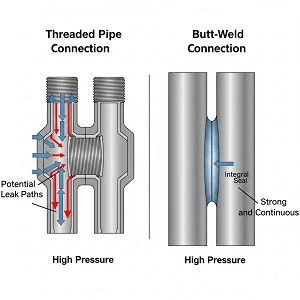
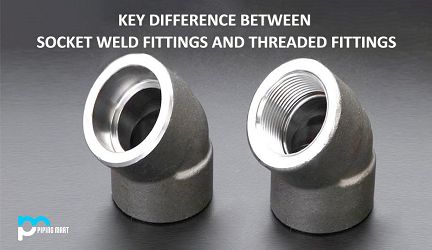
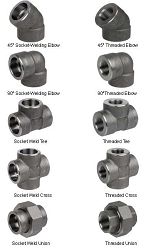
Threaded Connection → Removable
Welded Connection → Permanent
2. HBFittings Threaded Fittings
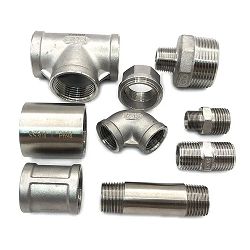
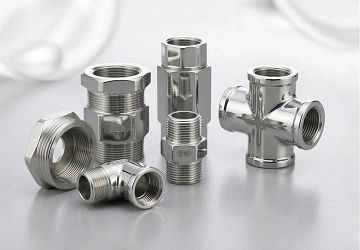
3. Socket Weld Fittings
4. Installation & Maintenance Comparison