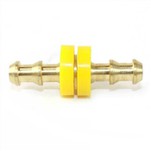
In modern industrial piping systems, pipeline connectors made of stainless steel have become core components in industries such as chemical engineering, metallurgy, construction machinery, instrument measurement and control, food and pharmaceuticals, thanks to their excellent corrosion resistance, high strength, high temperature resistance and anti-aging properties. Among them, stainless steel hydraulic fittings and stainless steel double ferrule fittings are the two most widely used types of connectors. Although both belong to stainless steel pipeline fittings, they differ essentially in design positioning, structural principle, specifications and applicable scenarios, and each has derived a variety of subdivided styles suitable for different working conditions.

Here is format , you can compare stainless steel hydraulic fittings and stainless steel double ferrule fittings difference . So that you can choose right products according to your actual useage sitation
| Comparison Dimension | Stainless Steel Hydraulic Fitting | Stainless Steel Double Ferrule Fitting | Key Difference |
|---|---|---|---|
| Core Definition | A general term for special pipeline connectors in industrial hydraulic systems, including various forms such as ferrule, welding, flaring and crimping. | A high-end subdivision type of precision instrument pipe fittings, specifically referring to seals adopting double ferrule structure, belonging to a single standardized category. | Hydraulic fitting is a system-level concept; double ferrule fitting is a product-level concept (and a subset of hydraulic fitting with different focuses). |
| Structural Design | Overall heavy and diverse in structure. The structures of body, nut and sealing surface vary greatly according to different styles. For example, crimping type includes fitting core and sleeve; welding type includes groove. | Exquisite structure and unified standard. Composed of four parts: fitting body, front ferrule, rear ferrule and nut. The body has moderate wall thickness without redundant structure. | Hydraulic fittings are designed to be sturdier to adapt to high pressure and vibration; double ferrule fittings are designed to be more compact to adapt to precision pipelines. |
| Sealing Principle |
Composite multi-mechanism. 1. Ferrule type: the ferrule bites the pipe wall. 2. Welding type: metal fusion by welding seam. 3. Crimping type: interference extrusion between rubber hose and fitting core. |
Single metal elastic sealing. Tighten the nut, the rear ferrule pushes the front ferrule to bite into the pipe to form the main seal; the rear ferrule holds tightly radially to provide compensation force. Metal-to-metal zero leakage. | Hydraulic fittings rely on structural fit or welding; double ferrule fittings rely on interference force generated by metal deformation, with more micro-stable sealing performance. |
| Pressure Rating | Extremely high and wide coverage. Ferrule type: 25-63 MPa. Welding type: 100 MPa+. Crimping type: up to 800 MPa (ultra-high pressure working conditions). | Medium and high pressure with precise control. Conventional range: 25-63 MPa. Rarely used in ultra-high pressure hydraulic systems, mainly suitable for medium pressure precision circuits. | Hydraulic fittings have stronger resistance to instantaneous impact and peak pressure; double ferrule fittings focus on long-term stability under rated pressure. |
| Assembly & Disassembly | Obvious differentiation. Ferrule type: limited assembly and disassembly. Welding / crimping type: non-detachable (one-time connection, pipe cutting required for removal). | Super reusability. Disassemblable for more than 100 times. Replace the ferrule or retighten to restore sealing without damaging the pipe. | Hydraulic fittings (welding / crimping) have high maintenance cost; double ferrule fittings have excellent maintainability, suitable for pipelines requiring frequent modification. |
| Applicable Tubing | Extremely wide range. Suitable for large-diameter, thick-walled seamless steel pipes, hydraulic hoses, copper pipes, etc. Wide pipe diameter range (DN6 - DN50+). | Precise range. Mainly suitable for small and medium-diameter, thin-walled seamless stainless steel pipes and copper pipes. Pipe diameter concentrated at Φ3mm - Φ25mm. | Hydraulic fitting pipelines are thicker and stiffer; double ferrule fitting pipelines are thinner and smaller. |
| Installation Complexity | High threshold, requiring professional equipment. Torque wrench, crimping machine, welding equipment / workers required. High construction precision requirement and long construction period. | Low threshold, convenient and efficient. Only ordinary torque wrench required for installation. No welding or special tools needed, fast construction. | Hydraulic fittings rely heavily on construction technology; double ferrule fittings can be operated manually, suitable for rapid installation. |
| Medium Compatibility | Special and heavy-duty. Mainly suitable for hydraulic oil, lubricating oil and emulsion. Good oil resistance, but weak adaptability to pure gas / high-purity liquid. | Broad-spectrum and clean. Suitable for hydraulic oil, high-purity gas, acid-base liquid, food-grade fluid and corrosive medium. | Hydraulic fittings are prone to cavitation; double ferrule fittings are cleaner, suitable for scenarios requiring fluid purity. |
| Main Style Classification | 1. Ferrule hydraulic fitting (single / double ferrule) 2. Welding fitting (butt welding / socket welding) 3. Flaring fitting (bell mouth) 4. Crimping fitting (special for rubber hose) 5. Flange fitting | 1. Straight type (terminal / intermediate / reducing) 2. Elbow type (45°/90°) 3. Tee type (equal diameter / reducing diameter / terminal) 4. Special function type (bulkhead / pressure gauge / plug / cross) | Hydraulic fittings have more diverse styles, classified by connection mode; double ferrule fittings have more regular styles, classified by pipeline direction. |
| Typical Application Scenarios | Engineering machinery, metallurgical equipment, hydraulic pump station, machine tools, ships, mining equipment (high-pressure power circuit). | Instrument measurement and control, semiconductor high-purity gas circuit, laboratory pipeline, food and pharmaceutical clean pipeline, fine chemical industry (precision measurement / transmission). | Hydraulic fittings are used to provide power to equipment; double ferrule fittings are used for fluid transmission / parameter monitoring. |
| Core Advantages & Disadvantages | Advantages: high pressure resistance, strong vibration resistance, large bearing capacity. Disadvantages: high cost, difficult installation, non-detachable (welding type). | Advantages: no leakage, high cleanliness, convenient assembly and disassembly, high cost performance. Disadvantages: not suitable for ultra-high pressure and severe vibration working conditions. | Hydraulic fitting is a hardcore heavy-duty choice; double ferrule fitting is a precision maintenance choice. |
If your system involves hydraulic pump stations, construction machinery, or large-caliber high-pressure transmission, be sure to select stainless steel hydraulic fittings (choose the corresponding type such as welded or crimped according to the material and hose / steel pipe).
If your system involves instrument pipelines, laboratory gas lines, fine chemicals, or small and medium-caliber clean transmission, stainless steel double ferrule fittings are the absolute first choice due to their excellent sealing performance and maintainability.