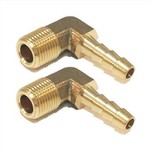
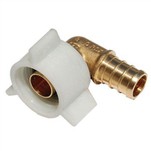
Brass push fit fittings are designed for situations where pipe connections need to be made quickly without soldering, brazing or extensive tooling. The fitting accepts the pipe through a push-in opening; an internal gripping mechanism holds the pipe while an O-ring provides the seal.
For buyers, the important part is not simply finding a "push fit brass fitting." Pipe material, outside diameter, working pressure, temperature, seal material, thread type and drinking-water requirements all need to match the installation.
HBFittings places Brass Push Fit Fitting alongside its brass compression fittings, PEX fittings, hose barb fittings, NPT pipe fittings and hydraulic fittings. Its current push-fit range includes Push Fit X MPT Adapter, Push Fit Coupling, Push Fit Elbow, Push Fit Tee and Push Fit X MPT Elbow.
1. What Is a Brass Push Fit Fitting?


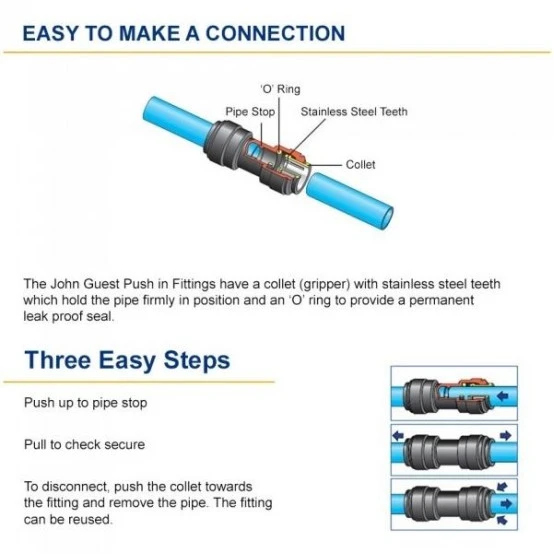
A brass push fit fitting is a mechanical pipe connector that joins tubing by simply pushing the prepared pipe into the fitting.
The main parts normally include:
Brass body
Gripping ring / grab ring
O-ring
Release collar
Connection port
Threaded section, where applicable
The gripping ring prevents the pipe from pulling out.
The O-ring provides the primary fluid seal.
This is different from a brass compression fitting, where the sealing action comes from tightening a nut and compressing a ferrule.
HBFittings describes its push-fit products as suitable for quick connection of PEX, copper and certain plastic pipes, with an internal O-ring or sealing element used for leak prevention.
2. Why Buy Brass Push Fit Instead of Plastic?


Plastic push-fit fittings can be suitable for many installations, but brass is often selected when the fitting body needs greater mechanical strength, durability or temperature resistance.
Brass offers:
Higher mechanical strength than many common plastics
Good dimensional stability
Good machinability
Good corrosion resistance
Compatibility with threaded metal components
A solid body suitable for demanding plumbing assemblies
HBFittings specifically manufactures its push-fit fittings from forged lead-free brass C46500 in the product examples currently listed on its site.
For a commercial or OEM project, this material specification is much more useful than simply writing "brass push fitting."
3. HBFittings Brass Push Fit Product Range


HBFittings currently lists several push-fit configurations.
Push Fit Coupling
Used to join two compatible pipes in a straight line.
Typical application:
Pipe → Push Fit Coupling → Pipe
Push Fit Elbow
Used when the pipe direction needs to change.
Typical version:
90° Push Fit Elbow
This is useful in confined plumbing spaces where making a soldered elbow would take additional preparation.
Push Fit Tee
Used to create a branch connection.
Typical layout:
Main Pipe → Tee → Branch Pipe
Push Fit × MPT Adapter
One end accepts the pipe through a push-fit connection while the other end uses a male pipe thread.
This is useful for connecting tubing to:
- Valves
- Manifolds
- Equipment
- Threaded adapters
Push Fit × MPT Elbow
Combines:
- Push-fit tube connection
- 90° direction change
- Male pipe thread
This is useful where a tube needs to connect directly to a threaded port.
These configurations are specifically shown in HBFittings' brass push-fit product category.
4. First Question: What Pipe Are You Connecting?


Do not order the fitting before confirming the pipe.
HBFittings identifies its push-fit fittings as compatible with PEX, copper and some plastic piping systems.
The pipe material affects:
Gripping performance
Sealing
Insert requirements
Working pressure
Temperature
Long-term reliability
Copper
Usually rigid and dimensionally stable.
PEX
Flexible and widely used in residential water distribution.
Plastic Pipe
Compatibility must be checked for the specific pipe material and dimensional standard.
For OEM purchasing, state the pipe material in the RFQ:
Push-fit fitting for PEX tubing
rather than:
Push fitting for water pipe.
5. Pipe Outside Diameter Is Critical


Push-fit fittings normally depend on the outside diameter (OD) of the tube.
This is different from hose barb fittings, where the hose inner diameter is a major selection parameter.
For example:
1/2" OD PEX → 1/2" Push Fit
The nominal pipe description alone may not be enough.
Before ordering, confirm:
- Pipe OD
- Wall thickness
- Pipe material
- Pipe standard
- Actual dimensional tolerance
A fitting that is nominally "1/2 inch" but intended for a different tube dimension can cause either insertion problems or leakage.
6. Lead-Free Brass Push Fit Fittings


One of the most important details on HBFittings' current push-fit products is the material:
Lead-free brass (C46500), forged
The listed push-fit coupling specifies C46500 lead-free brass and a maximum working pressure of 200 psi. The same product lists a temperature range of -10°C to 95°C.
This makes lead-free brass particularly relevant for:
Drinking-water plumbing
Residential water supply
Commercial plumbing
Water treatment equipment
HBFittings also states that lead-free brass is used where avoiding lead contamination is important, including drinking-water and food-contact applications.
However, "lead-free brass" and "certified for potable water" should not be treated as identical statements. The project should specify the required certification.
7. C46500 vs DZR Brass


HBFittings offers both C46500 lead-free brass and DZR brass CW602N/CW617N within its material portfolio.
They should not be confused.
|
Material |
Main consideration |
|
C46500 Lead-Free Brass |
Lead-content requirements |
|
CW602N DZR Brass |
Dezincification resistance |
|
CW617N DZR Brass |
Dezincification-resistant applications |
|
CA360 Brass |
Machinability |
|
CA377 Brass |
Brass components requiring forging |
If the project specification says:
Lead-free
focus on the applicable lead-content requirement.
If it says:
DZR
focus on the specified dezincification-resistant grade.
If it is a potable-water system requiring both, specify both requirements.
8. Push Fit Connection Mechanism


The connection can be understood in four stages.
Stage 1 - Pipe Preparation
Cut the pipe square.
Remove:
Burrs
Dirt
Scratches
Deformation
Stage 2 - Pipe Insertion
Push the pipe into the fitting until it reaches the required insertion depth.
Stage 3 - Gripping
The internal gripping mechanism holds the pipe.
Stage 4 - Sealing
The O-ring seals against the outside surface of the pipe.
HBFittings recommends cutting the pipe straight, cleaning the pipe end and pushing it into the fitting to the required depth. It also recommends leak checking after installation.
9. Pipe Preparation Before Installation


The fitting cannot compensate for a badly prepared pipe.
Before inserting the pipe:
Cut Square
A diagonal cut reduces the quality of the connection.
Remove Burrs
Sharp edges can damage the O-ring.
Clean the Surface
Remove:
- Dirt
- Oil
- Metal chips
- Oxidation
Check the Pipe
Avoid using a section that has:
- Deep scratches
- Cracks
- Severe deformation
- Ovality
This is particularly important because the O-ring seals against the pipe's outside surface.

10. How Deep Should the Pipe Go?
The insertion depth depends on the exact fitting design.
Do not use a generic depth from another manufacturer.
A practical method is:
- Cut the pipe square.
- Mark the pipe at the manufacturer's specified insertion depth.
- Push the pipe into the fitting.
- Confirm the mark reaches the reference position.
HBFittings' own installation guidance recommends measuring and marking the insertion depth, then pushing the pipe into the fitting until it reaches that depth.
For large OEM orders, the insertion-depth requirement should be included in the installation instructions or technical drawing.
11. Push Fit Working Pressure


Pressure rating must be checked against the exact fitting model.
For example, HBFittings' lead-free brass push-fit coupling lists:
Maximum working pressure: 200 psi
Temperature: -10°C to 95°C
for that product.
Do not automatically apply these numbers to every push-fit elbow, tee or adapter.
A purchase specification should ask for:
Maximum working pressure
Test pressure
Operating temperature
Applicable pipe material
Applicable pipe size
12. Temperature Selection
Temperature affects both the fitting and the sealing element.
Consider:
- Normal operating temperature
- Maximum temperature
- Short-term temperature spikes
- Fluid temperature
- Ambient temperature
The HBFittings push-fit coupling cited above specifies -10°C to 95°C.
If your system operates outside this range, ask for another product or seal configuration rather than assuming the standard model will work.
13. O-Ring Material Matters


The brass body is only one part of the connection.
The O-ring is in direct contact with the fluid and pipe surface.
Potential seal materials include:
- EPDM
- NBR
- FKM
- Other application-specific elastomers
The choice depends on:
- Water
- Oil
- Air
- Temperature
- Chemical exposure
For potable-water applications, the seal material should also meet the required certification.
When requesting an OEM fitting, include:
Brass material + O-ring material + fluid + temperature
rather than specifying the brass grade alone.
14. Brass Push Fit Fittings for Residential Plumbing


Residential plumbing is one of the most practical applications for push-fit fittings.
Typical locations include:
- Kitchen plumbing
- Bathroom water supply
- Water heater connections
- Repair sections
- Water filtration systems
- PEX distribution lines
Advantages for installers:
- No flame
- No soldering
- Fast connection
- Useful in confined spaces
- Easier repair work
HBFittings lists residential plumbing among its push-fit applications and specifically describes the fittings for PEX, copper and certain plastic pipes.
15. Commercial Building Plumbing


Commercial projects place more emphasis on:
- Installation speed
- Repeatability
- Leak prevention
- Inspection
- Certification
- Long-term maintenance
Typical applications:
- Hotels
- Offices
- Retail buildings
- Restaurants
- Apartment buildings
For larger projects, the procurement specification should include the complete fitting schedule rather than purchasing individual components by description.
16. Push Fit for Water Treatment Systems


HBFittings lists water treatment among the industries it serves.
Typical connections may include:
- Filter housings
- Water purification equipment
- Pumps
- Manifolds
- Distribution lines
For treated or potable water, check:
- Brass grade
- Seal material
- Lead requirements
- Certification
- Pressure
- Temperature
17. Push Fit Elbow vs Straight Coupling


|
Fitting |
Main use |
|
Straight Coupling |
Join two pipes |
|
90° Elbow |
Change pipe direction |
|
Tee |
Create branch |
|
MPT Adapter |
Pipe-to-thread connection |
|
MPT Elbow |
Direction change + threaded connection |
HBFittings' current product range includes all five configurations.
18. Push Fit × MPT Adapter


The push-fit × MPT adapter is particularly useful in equipment installation.
One side:
Push-fit tube connection
Other side:
Male pipe thread
Possible applications:
- Valve connection
- Manifold connection
- Equipment inlet
- Water heater
- Filter housing
HBFittings lists a Push Fit X Mpt Adapter in its product category.
When ordering, specify:
Push-fit × 1/2" Male NPT
rather than just:
Push-fit adapter.
19. NPT, BSPP and BSPT


Thread selection depends on the equipment connection.
NPT
Widely used in North America.
BSPP
Parallel British Standard Pipe thread.
BSPT
Tapered British Standard Pipe thread.
A wrong thread can result in:
- Leakage
- Damaged threads
- Incorrect engagement
- Installation delays
HBFittings' published push-fit coupling specification states that its threaded connection complies with ANSI B1.20.1.
For export projects, state the thread standard explicitly.
20. Push Fit vs Compression Fittings


|
Item |
Push Fit |
Compression |
|
Installation |
Push pipe in |
Tighten nut |
|
Special installation tool |
Usually not required |
Wrench required |
|
Installation speed |
Fast |
Moderate |
|
Disassembly |
Designed for release |
Nut must be loosened |
|
Sealing |
O-ring |
Ferrule |
|
Typical pipe |
PEX, copper, selected plastics |
Copper, tubing, selected plastics |
|
Installation space |
Good for confined areas |
More clearance around nut |
HBFittings offers both categories, so customers can select the connection style according to the pipe system and installation method.
21. Push Fit vs PEX Fittings
This distinction is worth making because HBFittings lists Brass PEX Fitting and Brass Push Fit Fitting as separate categories.
PEX Fitting
Usually refers to a fitting designed specifically for a PEX connection method, such as:
- Crimp
- Clamp
- Expansion
Push Fit Fitting
Uses a push-to-connect mechanism.
The two categories can both be used with PEX, but the installation method is different.
For a project using PEX pipe, do not assume "PEX fitting" means "push fit."
22. Brass Push Fit vs Plastic Push Fit
|
Factor |
Brass Push Fit |
Plastic Push Fit |
|
Mechanical strength |
High |
Depends on polymer |
|
Temperature resistance |
Generally good |
Depends on material |
|
Threaded connections |
Excellent |
Depends on design |
|
Machining |
Excellent |
Not applicable |
|
Weight |
Higher |
Lower |
|
Cost |
Usually higher |
Usually lower |
|
Industrial use |
Strong candidate |
Application dependent |
HBFittings itself identifies brass push-fit fittings as an alternative to plastic push-fit fittings and points to brass's durability, strength and corrosion resistance.
23. Brass Push Fit Manufacturing


HBFittings' listed push-fit products use:
Lead-free brass C46500 + forging
The company also states that it uses full CNC machining, automated production lines and advanced testing equipment across its fitting manufacturing operation.
A typical production route can be:
C46500 Brass → Forging → CNC Machining → Deburring → Surface Finishing → O-Ring Assembly → Inspection → Pressure Testing → Packing
For OEM buyers, forging followed by machining can provide a good balance between material utilization, strength and repeatable dimensions.
24. What to Inspect on a Push Fit Fitting


Quality inspection should cover more than appearance.
Brass Body
Check:
- Cracks
- Pitting
- Surface defects
- Dimensions
Push-Fit Port
Check:
- Internal diameter
- Insertion depth
- Grip-ring position
O-Ring
Check:
- Material
- Size
- Surface condition
Threaded Port
Check:
- Thread size
- Thread gauge
- Thread profile
Finished Assembly
Check:
- Leakage
- Pull-out resistance
- Pressure performance
HBFittings states that it performs 100% inspection before shipment as part of its quality-control approach.
25. Installation Checklist
Before installation:
- Confirm pipe material
- Confirm pipe OD
- Cut pipe square
- Remove burrs
- Clean pipe
- Check for scratches
- Mark insertion depth
- Push pipe completely into fitting
- Confirm connection
- Pressure/leak test
HBFittings recommends leak checking after installation and pressure testing new installations before pipes are concealed behind walls or other structures.
26. Common Purchasing Mistakes
Mistake 1: Buying By Nominal Size Only
"1/2 inch" is not enough.
Confirm actual pipe OD.
Mistake 2: Ignoring Pipe Material
PEX, copper and plastic pipe can have different requirements.
Mistake 3: Assuming All Push-Fit Fittings Have the Same Rating
The pressure and temperature ratings belong to the specific model.
Mistake 4: Confusing Lead-Free with DZR
They are separate material requirements.
Mistake 5: Forgetting the Thread Standard
For an MPT adapter, specify:
1/2" MPT NPT
or the required BSP standard.
Mistake 6: Ignoring O-Ring Material
A fitting can have a suitable brass body but an unsuitable sealing material for the fluid.
27. OEM/ODM Brass Push Fit Fittings


For OEM projects, the supplier should receive more than a product name.
Provide:
Drawing
Include:
- Overall dimensions
- Push-fit port dimensions
- Thread details
- Insertion depth
- Tolerances
Material
Example:
C46500 Lead-Free Brass
Seal
Example:
EPDM O-ring
Application
Example:
Potable water
Pressure
Example:
200 psi maximum working pressure
Temperature
Example:
-10°C to 95°C
Quantity
Example:
50,000 pcs/year
HBFittings states that it supports OEM projects, product development and engineering customization, and provides drawing-based production.
28. Brass Push Fit Fittings Buyer Checklist
Pipe
- Copper
- PEX
- Plastic
- Pipe OD confirmed
- Wall thickness confirmed
Fitting
- Coupling
- Elbow
- Tee
- MPT adapter
- MPT elbow
Material
- C46500 lead-free brass
- DZR brass if specified
- Other brass grade
Sealing
- O-ring material
- Potable-water compliance if required
Connection
- Push-fit size
- NPT
- BSPP
- BSPT
Performance
- Working pressure
- Test pressure
- Temperature range
- Fluid compatibility
Quality
- Material certificate
- Thread inspection
- Dimensional inspection
- Leak test
- Pressure test
29. How to Write the RFQ
Instead of:
Brass Push Fit Fitting, 1/2", 10,000 pcs
use:
1/2" OD PEX Push Fit Coupling, C46500 Lead-Free Forged Brass, Max. Working Pressure 200 psi, Operating Temperature -10°C to 95°C, Potable Water Application, 10,000 pcs.
For an adapter:
1/2" OD PEX Push Fit × 1/2" Male NPT Adapter, C46500 Lead-Free Brass, Forged, Potable Water Application, 10,000 pcs.
This gives the manufacturer enough information to confirm the correct model rather than making assumptions.