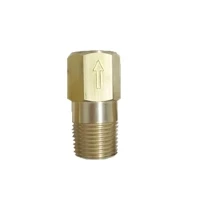
As a supplier of stainless steel pressure gauge adapters, I’ve lost count of how many times I’ve heard the same question from engineers, maintenance technicians, and small-scale manufacturing owners: “What thread type do I need for my stainless steel pressure gauge adapter?” It’s not a trivial question—get the thread wrong, and you’re looking at leaks, inaccurate pressure readings, or even system failures that cost you time, money, and safety. Over the past 12 years working with fluid and pressure system components, I’ve learned that thread selection for these adapters isn’t one-size-fits-all, and most of the confusion comes from mixing up standards that evolved for different industries and regions.
Let’s start with the basics: a pressure gauge adapter is the connector that links your gauge to a process line, tank, or valve. For stainless steel adapters specifically, the material itself is a big clue to the intended use—we supply Stainless Steel Pressure Gauge Adapter for applications ranging from food and beverage processing to oil and gas, where corrosion resistance and durability in harsh conditions are non-negotiable. But the thread is what makes that connection reliable.
The Most Common Thread Types for Stainless Steel Pressure Gauge Adapters
I see three thread formats pop up in 90% of the orders we process, so let’s break them down with clear use cases, since matching your thread to your application is the only way to avoid problems.
- NPT (National Pipe Thread)
NPT is by far the most widely used thread in North America, and it’s the default for most general-purpose pressure gauge adapters. It’s a tapered thread—meaning the outer diameter gets slightly smaller at the end of the adapter, and the inner diameter gets slightly smaller on the mating part (like a pressure gauge’s port or a process fitting). Tapered threads create a metal-to-metal seal when tightened, no extra sealant needed for low to medium pressure applications, though teflon tape is often recommended for extra security in higher pressure or vibrating systems.
The key thing to remember about NPT is that it’s not interchangeable with other tapered threads like BSPT. A lot of our customers accidentally order the wrong thread when working with international equipment, so double-checking is critical. For example, if you’re retrofitting a gauge on an old North American water system, NPT is almost certainly what you need. For our Stainless Steel Pressure Gauge Adapter, we offer NPT sizes from 1/8” to 2” to fit almost any standard gauge port.


-
BSPT (British Standard Pipe Taper)
BSPT is the counterpart to NPT, used widely in Europe, Asia, and many Commonwealth countries. Like NPT, it’s a tapered thread, but the angle of the taper is slightly different (1.789 degrees per side for BSPT vs. 1.85 degrees for NPT) and the pitch (threads per inch) is also not the same. That means an NPT and BSPT thread will never seal properly, even if they look close. I’ve had customers send us photos of mismatched threads trying to force a connection, and it’s always a mess—stripped threads, gaps, and no way to get a tight seal. We also offer BSPT stainless steel adapters for customers working with international systems, and we always label them clearly to avoid confusion. -
BSPP (British Standard Pipe Parallel) / G-Thread
Here’s where things get a little confusing. BSPP (also called G-thread) is a parallel (straight) thread, not tapered. It doesn’t seal on the threads themselves—instead, you use a gasket, o-ring, or sealant between the face of the adapter and the gauge or fitting to create a seal. This is common in applications where you need consistent, repeatable connections without relying on thread tightness, like in hydraulic systems or high-purity processes where sealant or tape could contaminate the fluid. For many food and beverage clients, BSPP is their go-to, because the o-ring seal ensures no leaks and no foreign material gets into the product. We also offer adapters in parallel threads, and I always make sure to explain the difference between parallel and tapered to customers who are new to international standards.
When to Choose Stainless Steel vs. Brass Adapters (And How That Ties to Thread)
A lot of people ask why we offer both stainless steel and Brass Pressure Gauge Adapter options, and the thread type is often tied to that choice. Brass adapters are great for low-pressure, non-corrosive applications like residential plumbing or general air systems, but they’re not suitable for harsh environments—like saltwater, acidic fluids, or high-temperature processes. That’s where stainless steel comes in: 316 stainless steel, which is what we use for all our stainless adapters, is corrosion-resistant, strong, and can handle pressures up to 10,000 PSI (depending on the size and thread type).
For example, a customer building a marine water treatment system came to us last year because their brass adapters were corroding within six months. They were using 1/4” BSPP threads, and we supplied them with 316 stainless steel adapters in the same thread size—so they didn’t have to modify their existing gauges or process lines, just swap out the adapters. That’s the sweet spot: when you match your thread type to your existing components and upgrade the material to stainless steel, you get both reliability and compatibility.
Common Mistakes I See (And How to Avoid Them)
Over the years, I’ve seen enough mistakes to write a whole post on this, but here are the three most frequent ones related to thread types:
- Mixing tapered and parallel threads: Trying to put a tapered NPT adapter into a parallel BSPP port, or vice versa, is a quick way to get a leak. Always check the port on your gauge or process line—if it’s tapered (has a cone shape), you need a tapered thread adapter; if it’s straight, you need a parallel thread adapter.
- Ignoring regional standards: If your equipment is made in the U.S., it’s almost certainly NPT. If it’s made in Europe, it’s BSPT or BSPP. I once had a customer from Germany order a stainless steel adapter with NPT threads, and when it didn’t fit, he was confused until we checked—his gauge had BSPP threads, not NPT. That’s why we always ask for the gauge’s thread size and the application when a customer reaches out, to avoid that kind of mix-up.
- Assuming all threads labeled “1/4” are the same: A 1/4” NPT thread has 18 threads per inch, while a 1/4” BSPP thread has 19 threads per inch. Even though they look almost identical, you’ll never get them to thread together properly. We have a thread gauge set in our warehouse that we use every day to confirm sizes, and I recommend every technician invests in one—small tools that save you from big headaches.
How to Pick the Right Thread Type for Your Stainless Steel Pressure Gauge Adapter
If you’re still unsure which thread you need, here’s a step-by-step guide I give every customer:
- Check your existing gauge or process line: Look at the port where the gauge connects. Is the inside of the port tapered (wider at the entry, narrower deeper in)? That’s tapered thread. Is it straight all the way? That’s parallel thread.
- Check the documentation for your equipment: The manual for your pressure gauge or process tank will almost always list the thread type and size. If you can’t find the manual, take a photo of the port and send it to us—we can help identify the thread.
- Consider your application: If you’re working with high pressure, harsh chemicals, or outdoor environments, stainless steel is non-negotiable. For those applications, stick to tapered NPT or BSPT if you want a metal-to-metal seal, or parallel BSPP if you need an o-ring seal for extra leak protection.
At the end of the day, thread type is just one part of a reliable pressure system, but it’s a critical one. I’ve seen a $50 stainless steel gauge get ruined by a $2 wrong thread on an adapter, and that’s a mistake no one can afford.
If you’re working on a project and need a stainless steel pressure gauge adapter, or if you’re not sure which thread type is right for your setup, feel free to reach out. We work with everyone from small workshop owners to large industrial facilities, and we make sure every adapter we supply fits perfectly and works as intended. Whether you need NPT, BSPT, BSPP, or a custom thread, we can help you find the right solution for your needs.
References
- American National Standard Pipe Threads (NPT/NPS) - ASME B1.20.1
- British Standard Pipe Threads (BSPT/BSPP) - BS EN 10226-1
- Stainless Steel Pressure Vessel and Component Material Standards - ASTM A240/A240M
- Pressure Gauge Adapter Application Guidelines - Parker Hannifin Fluid Connectors Division
- Thread Sealant and Gasket Selection for Pressure Systems - Fluid Power Journal, 2022