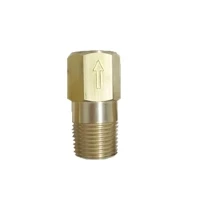
If you’ve ever stood in front of a gas control panel, troubleshooting a line that cycles on and off, you’ve probably wondered whether your valve is up to the job. As someone who’s spent the last 12 years selling and refining brass gas valves—most notably our line of precision components—I get this question all the time, especially when it comes to intermittent gas flow applications. These are setups where gas isn’t flowing nonstop: think of commercial kitchen pilot lights, lab test stands that only run during experiments, or small manufacturing lines that start and stop with production shifts. Intermittent flow puts unique stress on valves: repeated opening and closing, temperature swings, and the need for tight sealing when the line is inactive. The valve I’m asked about most often here is our Brass Gas Female Needle Valve, and after working with hundreds of customers on both sides of this application, I want to break down exactly whether it’s a good fit, when it shines, and when you might want to look at a different component.
First, let’s ground this in what an intermittent gas flow application actually demands. It’s not just “turning a valve on and off.” For valves used with natural gas, propane, or even inert industrial gases, intermittent operation means three non-negotiables: leak-tight shutoff when the valve is closed, consistent performance over thousands of cycles, and resistance to wear from the repeated friction of the stem and seal. A valve that leaks when closed is a fire hazard, and one that fails after a few hundred cycles is a costly headache for maintenance teams. These requirements are where the brass gas female needle valve design has distinct advantages, but they aren’t universal—you have to match the right model to your specific use case.
Let’s start with the core design of our Brass Gas Female Needle Valve. Unlike ball valves, which use a rotating bore to open and close, needle valves use a tapered, pin-shaped stem that threads into a matching seat. When you turn the handwheel, the stem moves up or down, creating or restricting a narrow annular gap between the stem and seat. For intermittent applications, this design is a game-changer because of how the seal works: when closed, the tapered stem wedges tightly into the seat, creating a metal-to-metal or metal-to-PTFE seal (depending on our model) that’s far more reliable for zero-leak shutoff than a ball valve’s O-ring seal in many cases. That’s a big win for gas lines, where even a tiny leak over time can add up to safety risks or wasted product.
But it’s not just the seal—brass itself is a key part here. Our valves use lead-free brass alloy, specifically formulated for gas service, which resists corrosion from moisture, hydrogen sulfide, and other common contaminants in natural gas lines. That durability translates to consistent performance over cycles. In intermittent applications, a valve that only runs a few times a week might sit idle for months at a time; brass doesn’t seize up like steel can, so you won’t find yourself fighting a stuck handwheel when you need it. I had a customer in Ohio a few years back who uses our Brass Gas Female Needle Valve for a small propane line that feeds a commercial fryer, only turned on when the restaurant opens. He told me after three years of use, it’s still as smooth as the day he installed it—no seizing, no leaks. That’s the kind of real-world performance you don’t get with cheaper valve materials.
That said, needle valves aren’t one-size-fits-all for intermittent flow, and there are important caveats to consider. First, let’s talk about cycle life. While our standard Brass Gas Female Needle Valve is rated for up to 10,000 full open/close cycles, that’s only when it’s operated within its pressure and temperature limits. For applications that cycle more than that—think a lab test stand that runs 8 hours a day, 5 days a week for years on end—you might want to look at a high-pressure variant. Our Brass Instrument High Pressure Needle Valve is built with a reinforced stem and a more robust seat design, rated for 20,000+ cycles, making it better suited for heavy, frequent intermittent use. I’ve seen standard needle valves wear out in as little as 2,000 cycles when used for high-frequency operation, so matching the cycle count to your valve’s rating is non-negotiable.
Another consideration is flow regulation. A lot of intermittent gas flow applications need more than just on/off—they need to adjust the flow rate when the line is active. Needle valves excel here because their narrow stem gap allows for precise, fine-tuned flow control, which is perfect for applications like gas chromatography labs, where even a 0.1 SCFM change in flow can throw off test results. For these setups, our Brass Gas Female Needle Valve’s female NPT ends make it easy to integrate into existing piping, whether you’re running copper line for natural gas or stainless steel for higher-pressure propane. But if your intermittent application is just a simple on/off switch with no need for flow adjustment, you might find a spherical valve is more cost-effective. For example, our PN 100 Brass Spherical Valve With Plate is designed for quick, full-bore on/off, with a lower price point than a needle valve, and rated for 50,000+ cycles—ideal for applications that only need to open or close, no regulation.
Pressure is another make-or-break factor. Most residential and light commercial intermittent gas lines run at 125 PSI or lower, which is well within the standard Brass Gas Female Needle Valve’s rating. But if you’re working with high-pressure gas lines—like those used in industrial furnaces or specialty manufacturing—our standard model tops out at 1000 PSI, so you’ll need a heavier-duty option. Our Brass Male To Female Needle Valve is often used for high-pressure intermittent applications, thanks to its reinforced connection points, or the 90 Degree Angle Needle Valve, which is perfect for space-constrained piping where a standard straight needle valve won’t fit. I once had a customer in the petrochemical space who was using a standard female needle valve for a 1500 PSI propane line that cycled twice a day, and after six months, the stem started leaking around the packing. Swapping it for a male-to-female high-pressure model solved the issue, so pressure class is not something to overlook.


Wear and tear on the stem and seal is also a big deal for intermittent use. When a valve is open for long periods, the stem doesn’t move much, so wear is minimal. But in intermittent use, every cycle moves the stem a fraction, and over time, the packing material (which seals the stem to the valve body) can degrade. Our standard Brass Gas Female Needle Valve uses PTFE packing, which is resistant to gas chemicals and works well for most applications, but if you’re working with corrosive gases like chlorine or high-temperature gas (above 200°F), graphite packing is a better choice. We offer that as a custom upgrade, and it’s a small change that can extend the valve’s life by years in harsh intermittent service.
Let’s talk about common myths that trip people up here. The first myth is that needle valves are too slow for intermittent on/off. That’s only true of very small needle valves; our standard Brass Gas Female Needle Valve has a 1.5-inch handwheel, which opens or closes in about a quarter turn for 1/4-inch and 3/8-inch models, and a full turn for larger sizes. That’s fast enough for most commercial and industrial intermittent applications, and way more precise than a ball valve if you need to fine-tune flow. The second myth is that brass is too soft for gas service. Our lead-free brass alloy is specifically formulated for gas, tested to ANSI standards for pressure and corrosion resistance, and we back every valve with a 5-year warranty, so you don’t have to worry about it failing prematurely.
I also want to address a real-world example that’s top of mind for me right now. Last quarter, we worked with a craft brewery that needed to replace 12 valves in their carbon dioxide lines, which cycle on and off every time they fill a keg. The brewery was initially using ball valves, but they were leaking CO2 after a year of use, and the frequent cycling was causing the O-rings to wear out. We recommended the Brass Gas Female Needle Valve, and after three months of operation, the maintenance team reported zero leaks, and they’re able to adjust the CO2 flow rate to get consistent carbonation across all their beer styles. That’s exactly the kind of win that shows needle valves are ideal for intermittent applications that need both reliable shutoff and flow control.
So, to circle back to the original question: Is a Brass Gas Female Needle Valve suitable for intermittent gas flow applications? The short answer is yes—when you match the right valve model to your specific operating parameters. It’s a great fit if you need leak-tight shutoff, precise flow control, and durability in a design that resists seizing after periods of inactivity. But it’s not the best choice if you only need basic on/off functionality at low cycle counts, in which case a spherical valve would be more economical. And for high-frequency, high-pressure intermittent use, you’ll want to opt for our heavy-duty high-pressure needle valve lines, like the Brass Instrument High Pressure Needle Valve, to avoid premature wear.
If you’re currently troubleshooting an intermittent gas flow application and aren’t sure which valve is right for you, or if you’re ready to upgrade your current setup, don’t hesitate to reach out. Our team has decades of experience working with commercial and industrial clients across sectors, and we can help you select the perfect valve for your specific needs, whether that’s our standard Brass Gas Female Needle Valve, a high-pressure variant, or another brass valve option that fits your requirements.
References
- American Society of Mechanical Engineers (ASME). (2021). Valve Standards for Gas Service. ASME B16.34-2021.
- Brass Industry Association. (2022). Corrosion Resistance of Lead-Free Alloys for Gas Valves. BIA Technical Report 12-22.
- Lab Supply Manufacturers Association. (2023). Valve Cycle Life Requirements for Intermittent Gas Flow in Analytical Equipment. LSMA Guideline 07-23.
- Occupational Safety and Health Administration (OSHA). (2020). Process Safety Management for Gas Pipeline Valves. OSHA 3132-2020.