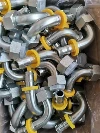
What are the methods of copper pipe processing? What are the technical requirements for copper pipe processing? What problems will be encountered in the process of copper pipe processing? So let's talk about what is copper tube first. The so-called copper pipe refers to the pipe which is pressed and drawn by copper, and it is also a seamless pipe. Copper pipe has the characteristics of light weight, good heat conductivity, strong and corrosion resistance, and is popular among people. Copper pipe is widely used in electrical and electronic industry and the most used.
Copper tubes can be divided into shape tubes and round tubes. The shape tube can be divided into elliptic tube, square tube, rectangular tube, triangle tube, hexagon pipe, drop pipe, five side pipe, outer inner circle pipe, spiral tube, inner rib pipe, outer rib pipe, plum blossom pipe, etc. Copper pipe is divided into extruded pipe, drawing pipe, welding pipe, hose and semi hard pipe according to production method and performance. Copper tubes can be made of copper, brass, bronze and white copper according to the alloy composition. Finally, it can be divided into condensing tube, air conditioning pipe, heat sink pipe, waveguide, oxygen generator tube, space tube and antenna tube according to the purpose. So now we are going to say that the copper tube processing.
Copper tube
The technical requirements for copper pipe processing are as follows:
1. The pipeline processing shall be carried out according to the design drawings, and the shape and size shall meet the design requirements.
2. The diameter change of fracture shall be within 2% of the standard diameter of copper pipe, and no flash or burr is allowed on the fracture.
3. The pipe fittings shall be degreased, decontaminated, free of copper chips, and the internal and external surfaces shall be smooth and clean, and there shall be no oil, scars and oxide skin.
4. Nitrogen must be filled for protection during welding process. After welding, the inside shall be blown out with 2.8-3.0mpa dry compressed air.
The processing methods of copper pipe are as follows:
1. The precision cutting of various fine tubules is carried out.
2. The cutting end surface grinding of various precision small tubules is processed.
3. The process of the various precision small tubules is processed by expanding and closing.
4. The bending and forming of various precision small tubes is made.
5. The side cutting of various precision small tubules is processed.
6. The welding and polishing of various precision small tubes is carried out.
7. The various fine tubules were processed by compression and expansion.
8. For various tubular products, multi station stretch forming products.
9. For pipe fittings, multi hole wall surface empty products.
The process of copper pipe processing is as follows:
Copper tube processing flow
There are three methods for copper pipe processing:
1. The definition of extrusion technology is that the copper tube is extruded by the copper tube extruder, so that the density distribution of copper tube is more uniform, the wall thickness is also distributed evenly, thus the compressive strength is stronger.
2. The definition of continuous casting continuous rolling is to pour molten copper into the continuous casting machine to produce copper billet (called continuous casting billet) after continuous casting and rolling. After cooling, it is directly connected to the copper rolling process formed by rolling in the hot continuous rolling unit after holding heat in the soaking furnace for a certain time. Continuous casting and rolling technology can skillfully combine casting and rolling. Compared with the traditional process of casting copper billet before heating in heating furnace, it has the advantages of simple technology, reducing labor force, increasing metal yield, saving materials, enhancing the quality of continuous casting billet, and producing energy saving and environmental protection copper products. It has realized mechanization directly The advantages of programming and automation.
3. The process explanation of copper pipe up and out: the original feature of updraft continuous casting copper pipe is "no oxygen", that is, oxygen content is below 10ppm, electrolytic copper is melted into copper liquid through high temperature melting, and the whole process after hardening and forming, such as charcoal reduction, flake graphite covering, oxygen isolation and other technical techniques are adopted. Oxygen is a new type of copper oxide and cuprous oxide in molten copper liquid. Under the action of high temperature, charcoal can deoxidize itself, making its oxygen content less than 10ppm. The oxygen separation of CO protective gas and flake graphite produced in the chemical reaction process will not be oxidized during crystallization, so as to achieve the effect of up lead process.
Equipment and operation requirements for blanking and deburring of copper pipe processing:
1. Tools: pipe cutting knife, effective straightedge, positioning block according to the size and diameter required by the drawing, take the corresponding length with straight measurement, and place the positioning block.
2. After the copper pipe is fixed, it is removed with a cutter to ensure that the cutting mouth is even and free from deformation.
3. Gloves are not allowed to be worn during operation, but gloves can be worn for deburring to prevent wool from entering copper pipe.
4. During cutting, copper pipe is fed evenly to ensure smooth pipe mouth.
5. When the pipe diameter is less than (equal to) Φ 12mm, multiple (no more than 10) can be cut together; When the diameter is greater than Φ 12 mm or less than 60mm long copper pipe must be separately blanking.