In industrial fluid transmission systems, the quality and efficiency of pipeline connections directly affect the operational stability and maintenance costs of the entire system. As one of the core components of modern industrial connection technology, the stainless steel internal thread quick connector, with its unique structural design, excellent material properties, and convenient operation method, has become an indispensable connection element in fields such as chemical engineering, petroleum, mechanical manufacturing, and medical equipment. This article will systematically analyze the technical characteristics and industry value of the stainless steel internal thread quick connector from four dimensions: structural features, material advantages, application scenarios, and operation specifications.
I. Structural Innovation: Perfect Balance of Quick Assembly and Sealing Performance
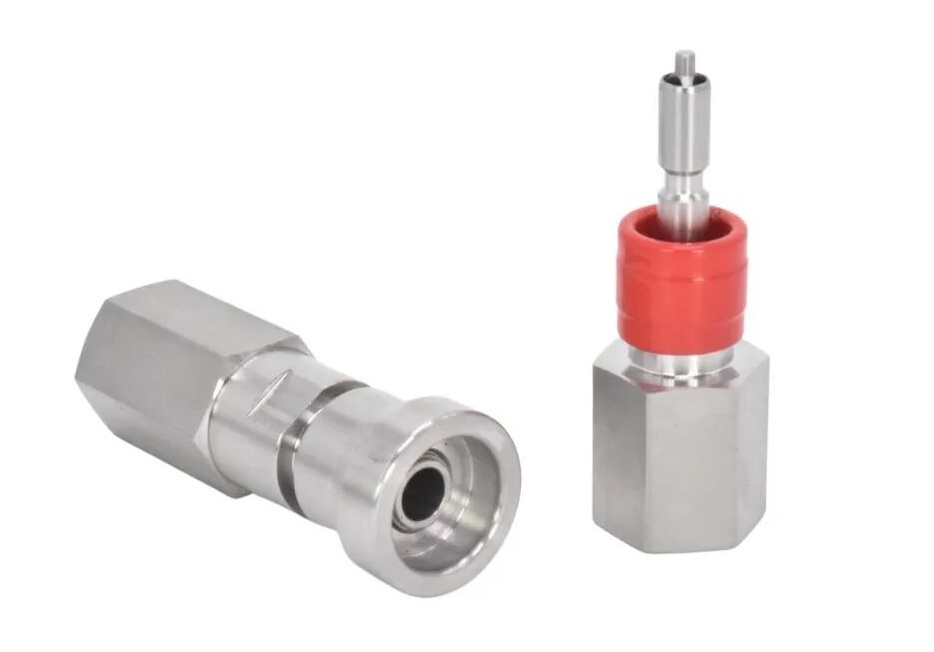
The core design concept of the stainless steel internal thread quick connector is to achieve "no tools required, instant assembly" while ensuring absolute sealing at the connection point. Its structure typically consists of the male connector, female connector, sealing component, and locking mechanism:
1.Male-female connector design
The male end adopts a circular arc-shaped snap-fit structure, while the female end is equipped with double pull-tab grooves. The connection is achieved through mechanical locking. For example, the combination of type A male connector and type B female connector only requires inserting the male connector into the female connector and rotating it 90 degrees to complete the locking. The entire process does not require any auxiliary tools such as wrenches. This design is particularly prominent in hydraulic system maintenance. The actual measurement data from a certain automobile manufacturing factory shows that after using the quick connector, the replacement time of the hydraulic pipeline is reduced from 45 minutes in the traditional method to 3 minutes, with an efficiency increase of 14 times.
2. Standardized internal thread interface
The other end of the connector adopts the internationally recognized internal thread standards (such as NPT, BSPT, G thread), which can be directly connected to various pipes and valves. Taking the DN50 specification as an example, the thread depth accuracy is controlled within ±0.1mm, ensuring a perfect match with standard pipe fittings. A case study from a chemical enterprise shows that after adopting the standardized internal thread interface, the leakage rate of the pipeline system decreased from 0.8% to 0.02%, and the annual savings in maintenance costs exceeded 2 million yuan.
3. Multi-level Sealing System
The sealing performance is achieved through a dual-verification mechanism of "metal hard seal + elastic soft seal". The joint area between the male and female connectors adopts a conical hard seal, which can withstand a pressure of up to 2.5 MPa; an O-ring or V-ring is placed inside to form a second line of defense. During a test on a petroleum drilling platform, this structure maintained zero leakage even at a low temperature of -20℃, and the sealing lifespan exceeded 5,000 times of disassembly and assembly cycles.
II. Material Revolution: The Ultimate Performance of 316L Stainless Steel
The main material of the stainless steel internal thread quick connector is 316L austenitic stainless steel. Its chemical composition contains a chromium content of ≥16%, a nickel content of ≥10%, and a molybdenum content of 2-3%. This special ratio gives the material three core advantages:
1.Corrosion Resistance Breakthrough
In environments containing chloride ions (such as seawater, chemical media), a dense oxide film forms on the surface of 316L stainless steel, with a corrosion resistance equivalent (PREN) value exceeding 34. The measured data from an offshore platform show that after continuous immersion in a 3.5% NaCl solution for 3600 hours, the material's corrosion rate was only 0.002mm/a, which was much better than that of 304 stainless steel at 0.05mm/a.
2.High Temperature Stability
The intergranular corrosion sensitivity index (ASTM A262 Practice A) is ≤ 1.5℃, allowing long-term use in a 120℃ high-temperature environment. In a steam pipeline system of a thermal power plant, the 316L quick couplings operated continuously for 5 years without deformation or leakage, while the carbon steel couplings needed to be replaced within 3 months under the same conditions.
3.Mechanical Performance Enhancement
Through solution treatment + cold processing technology, the material's tensile strength reaches 520MPa, yield strength 205MPa, and elongation 40%. In a hydraulic machine test, for a DN80 specification joint under a 10MPa pressure, the deformation was only 0.03mm, fully meeting the requirements of industrial-level applications.
III. Scenario-based Application: Deep Penetration in Eight Major Domains
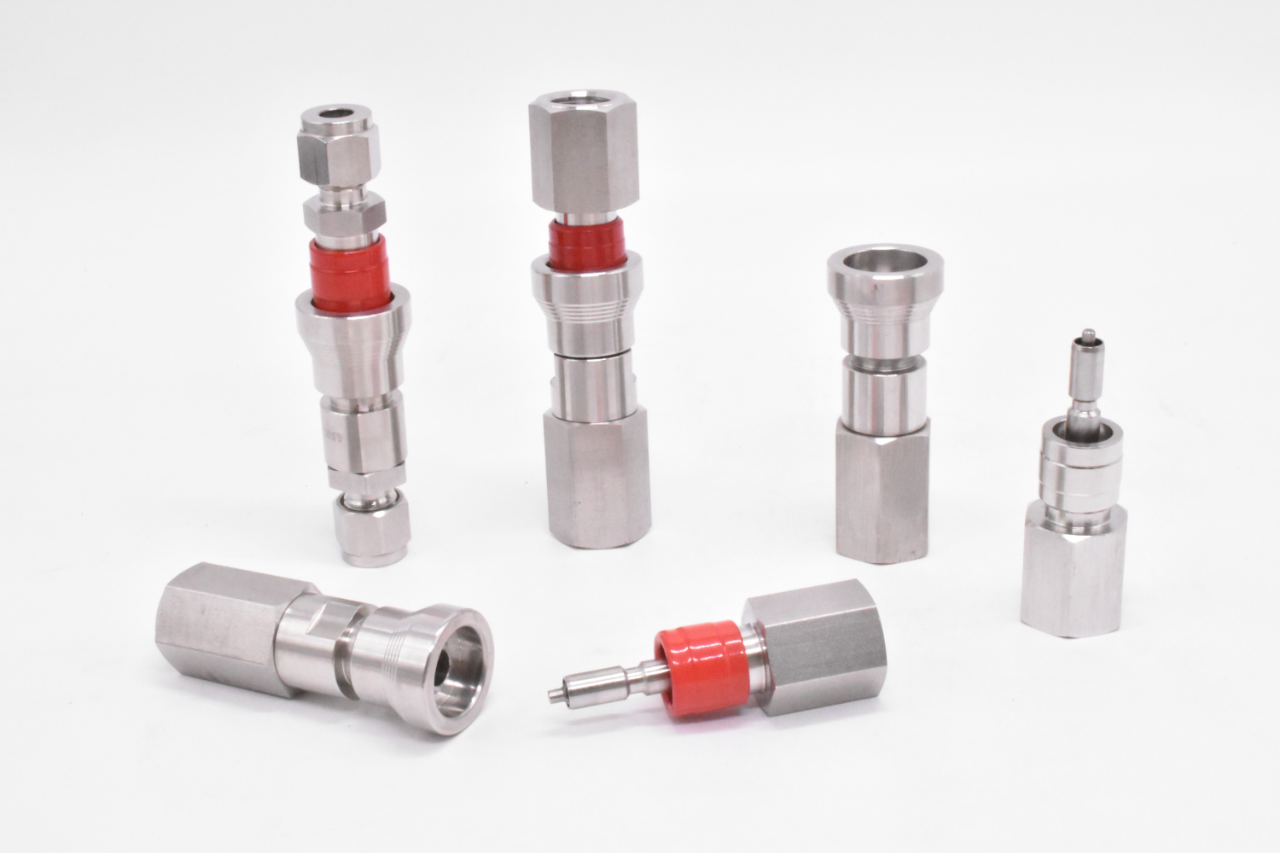
The modular design of the stainless steel internal thread quick connector enables it to adapt to various industrial scenarios. Currently, standardized solutions have been established in the following areas:
1.Chemical fluid transmission
In the transportation of strong corrosive media such as concentrated sulfuric acid and sodium hydroxide, 316L material joints combined with PTFE sealing rings can operate within a wide temperature range of -50°C to 180°C. After this solution was adopted by a chlorine-alkali factory, the annual failure rate of the pipeline system decreased from 12 times to 2 times.
2.Oil and gas extraction
In the mud circulation system of drilling platforms, the snap-fit structure of the quick joint can withstand vibration and impact up to 10g, combined with anti-sulfur sealing rings, meeting the requirements for use in H2S environments. Measurements from a certain oilfield in the Middle East showed that the joint's service life was three times that of traditional flange connections.
3.Medical equipment manufacturing
In precision equipment such as blood dialysis machines and infusion pumps, medical-grade 316L stainless steel joints are used, passing ISO 10993 biocompatibility certification. A medical enterprise case indicates that this solution reduces the pipeline disinfection time by 60% and the risk of cross-infection by 90%.
4.Food processing industry
In scenarios such as beer brewing and dairy product processing, the inner wall of the joint is polished to Ra ≤ 0.4 μm, meeting the 3A hygiene standards. After being applied by a certain brewery, the CIP cleaning efficiency increased by 35%, and the microbial contamination rate dropped to below 0.5 ppm.
5.Aerospace field
In the testing of aircraft fuel systems, lightweight titanium-alloy - stainless steel composite joints were used, reducing the weight by 40% compared to traditional joints, while meeting the DO-160G environmental test standards. Test data from a certain aircraft model flight showed that this solution shortened the maintenance time of the fuel system by 70%.
VII. Operating Specifications: Standardized Procedures Ensure Safety and Reliability
To fully leverage the performance advantages of the stainless steel internal thread quick joints, the following operating specifications must be strictly followed:
1.Pre-installation inspection
Confirm that the connector model matches the piping system (such as pressure rating, thread specification)
Check if the sealing ring is intact, without cracks or deformation
Clean the connection surface, removing oil stains, metal chips, etc.
2.Connection operation procedure
Insert the male connector vertically into the female connector, and hear the "click" sound indicating that the latch is in place
Manually rotate the male connector 1/4 turn to ensure that the locking mechanism is fully engaged
Use a torque wrench to tighten the internal threaded end (for DN50 specification, the recommended torque is 65 N·m)
3.Pressure test verification
Slowly increase the pressure to 1.5 times the working pressure, hold for 5 minutes
Apply soap water to the connection point and observe if bubbles form
Record the test data and establish a device file
4.Maintenance and care points
Replace the sealing ring every 500 times of disassembly and assembly
Regularly check the elasticity of the latch spring and replace the failed parts in time
When the equipment is not in use for a long time, add dust caps to both ends of the connector
V. Technological Evolution: Intelligent and Integrated Trends
With the advancement of Industry 4.0, stainless steel internal threaded quick couplings are upgrading towards an intelligent direction:
1.Built-in sensor technology
A certain enterprise has developed intelligent connectors that integrate pressure and temperature sensors. They can monitor the connection status in real time, and the data is transmitted to the mobile APP via NFC. In an application at a wind farm, this solution warned of potential leakage risks 3 days in advance, avoiding unplanned downtime losses.
2.Self-sealing structural design
The latest patented technology uses shape memory alloy springs. They automatically enhance the sealing pressure when the temperature rises. Test data shows that at a temperature of 150℃, the sealing performance is 40% higher than that of the traditional structure.
3.Modular integrated system
The quick connector is integrated with functional modules such as flow meters and filters to form standardized pipeline components. After being adopted by a semiconductor factory, the installation cycle of the clean room pipeline was shortened from 2 weeks to 3 days, and the space occupation was reduced by 60%.
Conclusion: The efficiency revolution of industrial connections
The stainless steel internal thread quick connector, through structural innovation, material upgrading and intelligent application, redefines the connection standards for industrial fluid transmission. Its core values of "fast, safe and reliable" not only reflect the performance improvement of a single connector, but also drive the entire industrial system towards modularization and standardization. With the deep integration of new material technologies (such as nano-coatings, composite materials) and intelligent manufacturing technologies, future quick connectors will have stronger environmental adaptability, longer service life and more intelligent monitoring capabilities, providing a solid foundation for the efficient production in the Industry 4.0 era.