In industrial piping systems, the reliability of connection components directly affects the operational efficiency and safety of the entire system. The stainless steel right-angle socket-on-through plate joint, with its unique structural design and material properties, has become a key component for solving connection problems in complex working conditions for pipelines. This article will systematically analyze the practical value of this industrial connection component from three dimensions: technical characteristics, application scenarios, and selection criteria.
I. Technical Characteristics: Three-dimensional Sealing and Structural Innovation
1.1 Dual Sealing Mechanism
The stainless steel right-angle socket-on-plate connection adopts the dual sealing technology of "mechanical interlocking + conical surface adhesion". When the nut is tightened, the front outer side of the socket forms the first metal hard seal with the conical surface of the connection body, while the inner edge of the socket uniformly bites into the outer wall of the steel pipe with a cutting depth of 0.1-0.2mm, forming the second radial seal. This design enables the connection to maintain zero leakage for 24 hours under a pressure of 10 MPa, reducing the leakage rate compared to traditional threaded connections by 97%. Data from a petrochemical enterprise shows that after using a 316L material connection, the gas pipeline leakage rate decreased from 0.3% to 0.01%, and the annual maintenance cost was reduced by 40%.
1.2 Innovative Structural Design
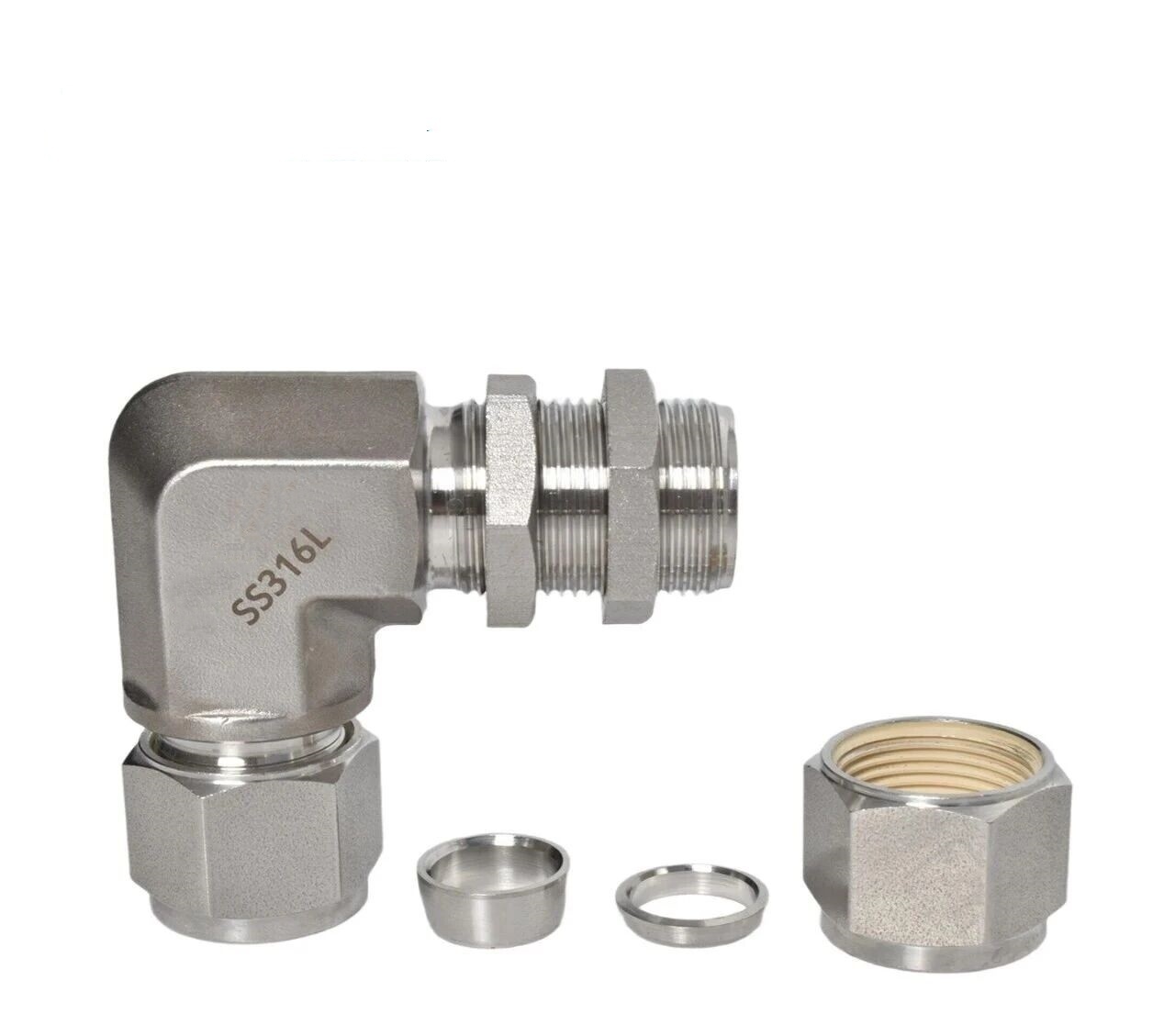
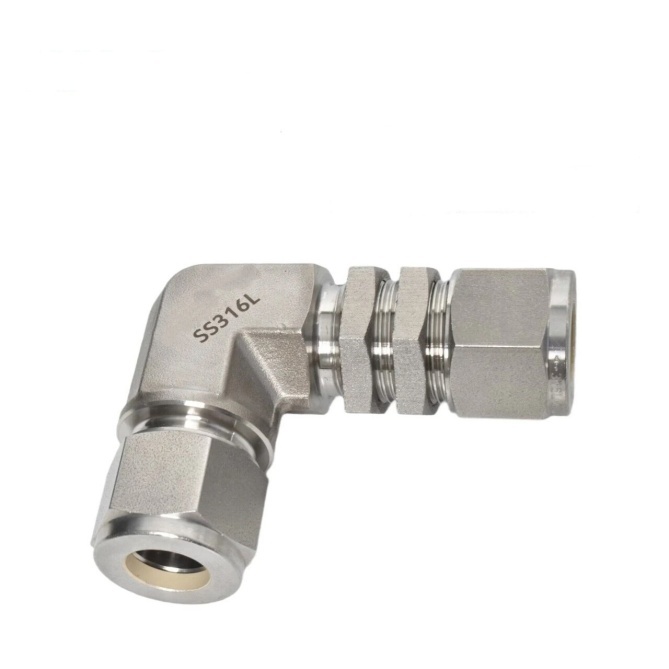
The right-angle socket-on-plate structure breaks through the spatial limitations of traditional straight-through connections and realizes efficient passage of the pipeline over obstacles such as partitions and walls through a 90° bending design. Its core components include:
Connection body: Made of 304/316L stainless steel forging, the inner conical surface angle is precisely controlled at 24° ± 0.5°, ensuring a perfect fit with the socket.
Double socket system: The front socket is responsible for radial contraction sealing, and the rear socket provides axial support. This design increases the pressure resistance of the connection to 63 MPa.
Pre-installed nut: Integrated torque control ring, which automatically limits the tightening force when the torque reaches 15-20 N·m, avoiding seal failure due to excessive tightening.
1.3 Material Performance Breakthrough The material selection directly affects the application range of the connection:
304 stainless steel: Suitable for food-grade CIP/SIP cleaning systems, with surface roughness Ra ≤ 0.8 μm, effectively inhibiting microbial growth.
316L stainless steel: Excellent corrosion resistance to chloride ions, with an annual corrosion rate of ≤ 0.05 mm in chloride-containing media, becoming the preferred dual-phase stainless steel for marine engineering.
Duplex stainless steel: The upper working temperature limit is increased to 600°C, meeting the requirements for supercritical fluid transportation. Titanium alloy material: Density is only 60% of steel, achieving lightweight connection in the aerospace field.
II. Application Scenarios: Cross-industry Solutions
2.1 In the crude oil transportation pipelines
the joints need to withstand extreme temperature differences ranging from -196℃ (liquid ethylene) to 450℃ (refining and processing facilities). After a certain refinery adopted the double socket structure joint, it solved the problem of traditional welding joints cracking under high temperatures, and the continuous operation cycle of the equipment was extended from 18 months to 36 months. For high-pressure hydrogen gas transportation, the joint was treated through a special heat treatment process to reduce hydrogen embrittlement sensitivity by 80%, ensuring the safety of long-term use.
2.2 In the food and pharmaceutical industry
the pipeline connectors for dairy production lines are required to meet the 3A hygiene standards. After an enterprise applied the socket joint, the qualified rate of product microbial indicators increased from 99.5% to 99.99%. Its modular design supports online cleaning (CIP) and steam sterilization (SIP), enabling rapid disassembly and assembly in the aseptic filling system, and reducing the single maintenance time to 15 minutes.
2.3 In the water treatment system
after the sewage treatment plant adopted the joint, the pipeline pressure drop decreased by 15%, and the annual energy savings reached 200,000 yuan. Its all-metal structure can resist chloride ion corrosion, and the inner wall smoothness reaches 0.4 μm, effectively preventing suspended matter deposition. In the seawater desalination project, the joint was treated through special coating processing, increasing the anti-salt fog performance to 1000 hours without rust.
2.4 In the new energy field
the cooling water system of the photovoltaic power station uses nylon joints with carbon black additives, extending the outdoor service life to 10 years. In the lubrication path of the wind turbine gearbox, the joint increases the rubber buffer sleeve to increase the vibration fatigue life from 5,000 times to 20,000 times. In the hydrogen storage and transportation process, the joint adopts a special sealing design to ensure the hydrogen permeability rate ≤ 1×10⁻⁸ Pa·m³/s, reaching international advanced levels.
III. Selection Key Points: Systematic Decision-making Model
3.1 Material Matching Principles:
Compatibility of media: Chlorine-containing media require 316L or duplex stainless steel, and strong acid environments recommend PFA/PVDF composite materials.
Temperature Adaptability: High-temperature conditions (>450℃) select nickel-based alloys, and low-temperature environments (-196℃) use austenitic stainless steel.
Pressure Grade: Select 25MPa/40MPa/63MPa based on the system design pressure. Customized reinforced structure is required for ultra-high pressure scenarios.
3.2 Structural Adaptation Scheme:
Space Optimization: Instrument piping adopts a straight-through intermediate union structure, reducing installation space requirements by 90%.
Quick Maintenance: The quick joint with locking rings shortens the maintenance time by 50%, suitable for frequent disassembly scenarios.
Vibration Conditions: The joint with an added rubber vibration damping sleeve can withstand 5g acceleration vibration while maintaining sealing integrity.
3.3 Installation Process Specifications:
Pre-installation Standards: Use a hydraulic pre-installation machine to control the embedding depth, and the pre-installation torque accuracy of the stainless steel joint needs to reach ±5%.
On-site Installation: The three "no" principles: Do not use sealant (may block damping holes), do not apply lateral force (easily lead to fatigue fracture), do not repeat disassembly (more than 3 times requires replacement of the sealing element).
Acceptance Test: After installation, a 2 times working pressure pressure retention test is required, and this method was used to detect 3 potential leakage points in the nuclear power project.
3.4 Intelligent Monitoring Upgrade:
A new generation of intelligent joints integrates an Internet of Things module,enabling real-time monitoring:
Sealing Status: Detect 0.1ml/min level of micro-leakage through a pressure sensor.
Temperature Abnormality: Built-in PT100 temperature probe warns of overheating risks.
Vibration Spectrum: Analyze vibration data to predict joint fatigue life. A research institution developed a self-diagnostic system with an error rate of less than 0.1%, which has been applied to deep-sea oil and gas extraction platforms.
IV. Future Trends: Technological Integration and Innovation
With the advancement of Industry 4.0, ferrule joints are evolving towards intelligence and lightweighting:
Material Innovation: Nano-coating technology has enhanced the corrosion resistance of the joints by 3 times, and graphene-reinforced composite materials have reduced the weight by 20%.
Structural Optimization: 3D printing technology enables the design of complex flow channels, reducing the flow resistance by 15%.
Intelligent Connectivity: Remote status monitoring through NB-IoT modules has extended the predictive maintenance cycle to 5 years.
Green Manufacturing: With a recyclable rate of 95%, the environmentally friendly design reduces the carbon emissions of a single joint by 15%.
The stainless steel right-angle ferrule through the deep integration of material science, precision manufacturing, and intelligent technology is redefining the technical standards for industrial pipeline connections. From deep-sea oil and gas extraction to space life support systems, its reliable performance continuously ensures the safe operation of modern industry. As technological iterations accelerate, this traditional connection component is regaining its vitality and becoming an important infrastructure for driving industrial upgrading.