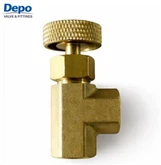
Hey there, fellow plumbers, HVAC techs, and industrial folks – if you’ve ever stared at a pile of valve parts trying to figure out which one’s actually right for your job, you’re in the right spot. I’ve been supplying brass male to female needle valves for over 12 years now, and let me tell you, half the calls I get are like, “Wait, isn’t all this valve stuff basically the same?” Nope, not even close. Today we’re breaking down exactly what makes our brass male to female needle valve different from other common valve types out there – no jargon, just real talk from someone who’s actually shipped hundreds of thousands of these things to jobsites across the country.
First off, let’s start with the basics so we’re all on the same page. A needle valve, in general, is designed for fine flow control – that’s the big thing. Unlike a ball valve that’s either all open or all closed (or somewhere in between but not precise), a needle valve has that thin, pointy stem that looks like a needle, right? It threads down into the seat to adjust how much fluid or gas gets through. Now, where our brass male to female version stands out is in the connection ends. One end is male (external threads) and the other is female (internal threads) – that’s not super unusual, but the way those threads are cut and the pressure rating we build into them is. Most male to female valves out there are cheap, throwaway ones for residential plumbing, but our brass ones are solid lead-free brass, rated for high pressure, which is a game-changer for industrial or commercial use.
Let’s compare that to the first valve type I get asked about all the time: the 90 Degree Angle Needle Valve. Wait, I’ve linked that one right here for you – check it out if you want to see the visual. That angle design is perfect when you need to turn a flow 90 degrees without adding extra fittings, right? But here’s the difference: our male to female valve is straight-through flow, so there’s no pressure drop from that turn. If you’re working with sensitive pressure gauges or small-bore lines where every psi counts, that angle valve might not cut it because the flow has to make a sharp turn. Our male to female version lets the fluid go straight from the male end to the female end, so pressure stays more consistent, no extra turbulence. I’ve had a lot of oil and gas techs switch to our valves from angle ones because they noticed their pressure readings were more stable – that’s the kind of real-world difference we’re talking about.
Next up, the Straight Flare Brass Needle Valve – I’ll link that too so you can see how its end connections work. Flare valves have those flared ends that you slide a copper tube into and tighten a nut down, no soldering needed. That’s great for some refrigeration or HVAC jobs, but guess what? Our male to female valve’s threaded connections are way more reliable for high-vibration environments. If you’re working on a compressor line or a piece of heavy machinery that’s shaking all day, flare fittings can sometimes come loose over time because the seal depends on that tube being perfectly flared. Our male to female threads are precision-cut, and when you tighten them to the right torque, they create a metal-to-metal seal that holds up even when the equipment’s vibrating like crazy. I had a mining client tell me they switched 20 of their flare valves to our male to female ones last year and haven’t had a leak since – that’s the kind of problem-solving that matters.
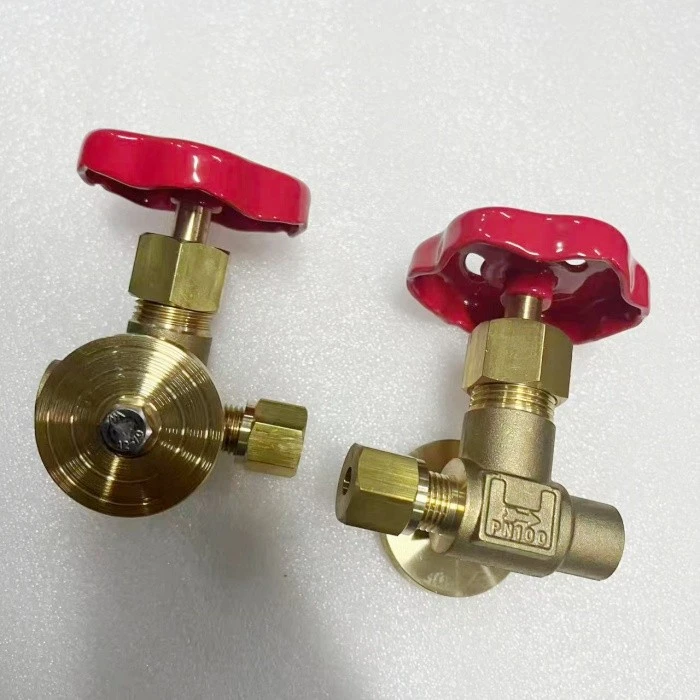
Now, let’s talk about spherical valves – wait, not the same as needle valves at all, even though they both use a stem. I’ve got a link for a PN 100 Brass Spherical Valve With Plate right here if you want to compare. Spherical valves (also called ball valves, but not the full-port kind) have a disc or a plate inside that slides in and out of the flow path. They’re designed for on/off control, not fine adjustment. If you try to use a spherical valve to dial in a small flow – like feeding a pressure gauge or regulating fuel to a small burner – you’ll either get nothing or way too much, because the disc is too big and blunt. Our male to female needle valve, on the other hand, lets you turn the stem a quarter of a turn and adjust the flow by 10% or even less. That’s why we’re the go-to for pressure gauge lines and small control loops – you can get exactly the flow you need, no overshooting.
Speaking of pressure gauges, let’s get to the ones made specifically for that: Control Pressure Gauge Needle Valve with flange and PN 100 Control Pressure Gauge – I’ll link both so you can see how those are built. Those valves are designed solely to isolate a pressure gauge so you can remove it without shutting down the whole line, right? But here’s the catch: they’re almost always three-way or have flange connections, which is overkill if you just need a straight-through valve to connect a gauge to a line. Our brass male to female valve is compact, so it doesn’t take up extra space on a tight panel, and since it’s male to female, you can thread it directly into the gauge and into your line without needing extra adapters. A lot of panel builders love that because it cuts down on parts, less chance of leaks from extra fittings, and installation is faster. I recently had a client who was using those dedicated gauge valves on a small boiler control panel – they switched to our male to female ones and cut their installation time per panel by 30% – that’s huge for projects on tight deadlines.
Wait, let’s make sure we’re clear on the other key differences too, beyond just connection type. First, material: all our valves are lead-free brass, which is not just for potable water (though they work great there) – brass is more corrosion-resistant than iron or even some stainless steels for many applications, especially when you’re dealing with mild chemicals or water with minerals. A lot of cheaper needle valves on the market are made from zinc-plated steel, which rusts after a year or two in damp industrial settings. We test every single batch for pressure – our PN 100 rated ones can handle up to 145 psi, which is way higher than residential valves, and even our standard ones are rated for 100 psi. That’s non-negotiable for us – no cutting corners on material or pressure testing.
Another big one: shutoff capability. A lot of people think all needle valves seal tight, but that’s not true. If a needle valve has a loose stem or a worn seat, it might leak when you close it. Our male to female valves have a PTFE seat that’s molded to fit the needle exactly, so when you thread the stem all the way down, it creates a bubble-tight shutoff. That’s critical if you’re working on natural gas lines or compressed air – you don’t want a leak that could cause a hazard. Compare that to, say, a gate valve, which is another common type people mix up. Gate valves use a wedge to block the flow, and they’re terrible for fine adjustment – once they’re open, they’re wide open, and if you use them to adjust flow, they get stuck or wear out fast. We don’t supply gate valves for a reason – they’re not built for the kind of control our needle valves do.
Let’s also talk about when you’d actually use our male to female valve vs. others, because that’s what this is really about. If you need fine flow control, consistent pressure, a straight-through path so no pressure drop, and reliable threaded connections that don’t need extra adapters, our valve is your guy. If you need to turn flow 90 degrees without extra fittings, go for that angle needle valve we linked. If you need a fast on/off for a main line, grab a spherical valve. If you need to isolate a pressure gauge without extra parts, those dedicated gauge valves work, but our male to female one is cheaper and faster to install.
I also want to address a common misconception: size. Our male to female needle valves come in sizes from 1/8” to 1” NPT, so they work for tiny gauge lines all the way up to small process lines. A lot of angle valves only come in up to 1/2”, so if you need a bigger line, that’s not an option. Straight flare valves are mostly 1/4” or 3/8”, so not great for larger flows. That versatility is another plus – you can use our valve in multiple spots on a job, which reduces the number of parts you need to stock.
Now, I know you’re probably thinking, “Okay, that sounds good, but how do I actually get one for my project?” I’m not going to leave you hanging here. If you have a job where you need fine flow control, reliable threaded connections, solid brass construction, and pressure ratings that don’t lie, reach out to us. We work with plumbers, industrial contractors, HVAC techs, and even small fabrication shops – no order is too small, and we can help you figure out exactly what size and rating you need, whether it’s for a residential water line, a chemical processing system, or a gas line for a generator.
Before I wrap this up, let’s recap the key differences so you don’t forget:
- Our brass male to female needle valve has a straight-through design, so no pressure drop, unlike angle needle valves.
- Precision-cut threaded connections are more vibration-resistant than flare fittings, no need for flaring tools.
- Built for fine flow control, not just on/off, unlike spherical valves.
- Compact, no extra adapters needed for gauge connections, compared to dedicated gauge valves.
- Lead-free brass construction, pressure tested to hold up to harsh conditions, unlike cheap zinc-plated valves.
If you want to see any of the other valve types we mentioned to compare them side by side, just click the links I dropped in here – they go straight to our product pages with specs, photos, and customer reviews. Trust me, after 12 years in this business, I’ve seen every mistake people make when picking valves, and I’d rather you get the right one the first time than deal with leaks or downtime later.

If you’re ready to order, need a quote, or just have questions about which valve is right for your job, don’t hesitate to get in touch. We’re here to help, not just sell you a valve.
References:
- Valve Technology: Needle Valves vs. Alternative Valve Types, Industrial Valve Association, 2022
- Brass Valve Material Corrosion Resistance for Industrial Applications, Journal of Plumbing and Industrial Equipment, 2021
- Flow Control Performance of Straight-Through vs. Angle Valves, American Society of Mechanical Engineers, 2020
- Pressure Gauge Isolation Valve Installation Best Practices, HVAC Contractors Association, 2023
- Vibration Resistance of Threaded vs. Flared Fittings in Heavy Machinery, International Society of Automation, 2022