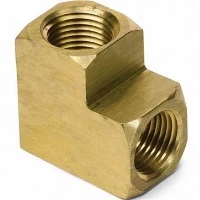
Can brass fittings be used in aerospace applications? That's a question I get asked a lot as a supplier of brass fittings. And it's a valid one, considering the high - stakes and demanding nature of the aerospace industry.
Let's start by looking at what brass is. Brass is an alloy made primarily of copper and zinc. The proportion of these two metals can vary, which results in different types of brass with unique properties. One of the great things about brass is its malleability. It can be easily shaped into various complex forms, which makes it a top - choice for manufacturing different kinds of fittings. We've got a bunch of options in our inventory, like the Brass NPT Thread Hex Pipe Nipple, the Dot Push In 90 Degree Male Elbow, the Brass Garden Hose Cap, the Brass Male and Female Extension Adapter, and the Brass Hose Barb Tee.
Now, coming back to aerospace applications. The aerospace industry has some seriously strict requirements. Components need to be able to withstand extreme temperatures, high pressures, and corrosive environments. They also need to be lightweight to keep the overall weight of the aircraft down, as every extra pound affects fuel efficiency and performance.
On the plus side, brass does have some features that make it promising for aerospace. First off, its corrosion resistance is pretty good. Depending on the kind of brass and the environment it's in, it can hold up well against rust and other forms of corrosion. In aerospace, where components are often exposed to things like moisture and chemicals, corrosion resistance is super important. A fitting that corrodes can weaken over time, leading to potential leaks or even failures.
Brass also has good thermal conductivity. In aerospace systems, there are often heat - related challenges. For example, in areas close to engines or electrical components, heat needs to be dissipated effectively. Brass can help with that by transferring heat away from sensitive areas.
But there are also some big downsides that prevent brass from being a widespread choice in aerospace. The most significant one is weight. Brass is relatively heavy compared to other materials commonly used in aerospace, like aluminum and titanium. In an industry where every ounce matters, the extra weight of brass can be a deal - breaker. Aircraft designers are constantly looking for ways to reduce weight to improve fuel economy and increase payload capacity. Using brass fittings could add unnecessary weight, undermining these efforts.
Another issue is its strength at high temperatures. While brass can handle normal operating temperatures in many aerospace systems, under extreme heat, its strength can start to degrade. This is a huge concern, especially for components near engines or in high - energy areas. If a fitting loses its strength, it can lead to leakages or structural failures, which are extremely dangerous in aerospace.
There are, however, some specific aerospace applications where brass might still find a place. In ground - based support equipment for aerospace operations, the weight factor might not be as critical. For example, in some maintenance tools or ground - based fluid handling systems, brass fittings can work just fine. They can provide the necessary corrosion resistance and ease of manufacturing at a reasonable cost.
In aerospace avionics systems, where there's a need for electrical conductivity, brass has potential. Brass is a good conductor of electricity, and in some low - power, low - stress electrical connections within an aircraft, it could be used. These connections won't be subject to the high - pressure, high - temperature conditions seen in other parts of the aircraft.
It's also worth mentioning that the aerospace industry is constantly evolving. There might be new alloying techniques or treatments in the future that could improve brass's properties, like reducing its weight or enhancing its high - temperature strength. This could open up more opportunities for brass fittings in aerospace.
So, to sum it up, while brass fittings do have some properties that make them appealing for aerospace, the weight and high - temperature strength issues currently limit their widespread use. But in certain niche applications where these drawbacks aren't as significant, brass can be a viable option.


If you're looking into brass fittings for any application, whether it's aerospace or something else, we're here to help. Our wide range of brass fittings, like the ones I mentioned earlier, are made to high - quality standards. We understand the different requirements of various industries and can work with you to find the right fitting for your needs. If you're interested in exploring our brass fitting options or have any questions, don't hesitate to reach out for a detailed discussion. We're happy to talk about how our products could fit into your specific project.
References:
- "Materials Science for Aerospace Engineering" textbooks.
- Industry reports on aerospace materials and their applications.